


Color matching
Matching corrects one batch at a time, so the model learns recipe to color from your own records and proposes the next mix.
Guide: match a color in fewer batches →
Binders, additives, pigments and process settings multiply fast.
Color, gloss, viscosity, durability and cost pull against each other.
Every batch costs time and material, so the order of trials matters.
Color, gloss, viscosity, and cost are coupled, so STOCHOS optimizes them as one problem and maps the trade-off frontier. Sensitivity analysis shows which ingredients and interactions drive each property.
Problems in coatings development and production that share one shape: panels that take weeks, ingredients that have to sum to a fixed total, and targets that pull against each other.
Matching corrects one batch at a time, so the model learns recipe to color from your own records and proposes the next mix.
Guide: match a color in fewer batches →
A raw material is restricted, discontinued or repriced, so the search rebalances everything else inside the recipe rules.
Guide: variants that respect constraints →
Force the preservative group to zero, hold the other targets, and let the search find what the rest of the recipe becomes.
How Bayesian optimization works →
Weathering answers arrive months after the decision is made, so short tests predict them with a stated limit on the extrapolation.
How multi-fidelity modeling works →
Opacity, gloss, viscosity and cost have no single best answer, so the search returns the front of trade-offs instead.
Guide: run fewer experiments →
Viscosity is a curve, not a number, so the model predicts the whole curve and scores a proposal against the target shape.
Guide: predict a full field →
Prices move, so sensitivity ranking shows what each raw material earns its place with, and cost enters the search as an objective.
How sensitivity analysis works →
Film build, flash-off and cure decide whether a recipe survives the line, so a few trials map the window where it holds.
How surrogate models work →
Normal was never written down as a number, so the model learns it from your release data and flags what falls outside.
Guide: know when a model is guessing →
Stability is answered by storing the can and waiting, so accelerated storage and early readings predict it with an interval.
How uncertainty is quantified →You get a few tries to mix an interior wall paint for the highest hiding power, keeping gloss and viscosity in spec and cost down. Then STOCHOS takes the same recipe, on the same score, and you see both answers side by side.
About 2 minutes · illustrative demo, synthetic data, response surfaces fitted offline from DIM-GP models

With partner Adler Lacke, a color match was reached after four adaptation cycles. Read the results
Figures from the Na, Logisch research project put about 40 percent of the primary energy in automotive production into painting, with up to 2,000 tonnes of paint waste avoidable. These are consortium figures, not PI results. Read the project note
Share the targets, the variables you can change, and the data you already have. We can outline where STOCHOS fits and what a first proof of concept could look like.
Ansys Technology Partner · part of CADFEM Group
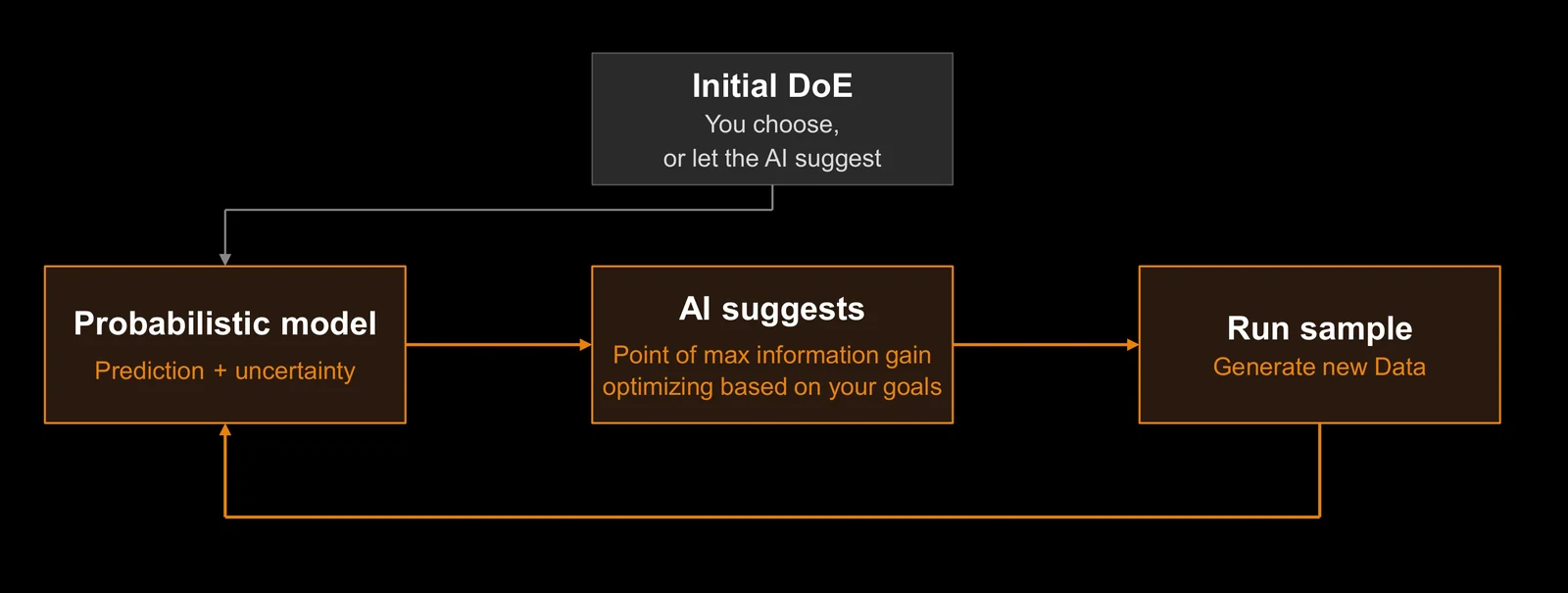
STOCHOS learns from your existing trials, then recommends which formulation to test next to reach the target with fewer experiments. Each new measurement updates the model, so the search adapts as results arrive. A reference example developed a coating with 17 parameters automatically within five adaptation cycles.
Yes. Formulation is a multi-objective problem, and STOCHOS uses multi-objective Bayesian optimization to balance competing targets rather than fixing one at a time, mapping a Pareto front of best compromises. Sensitivity analysis shows which ingredients and interactions matter most, so you can see the trade-off instead of guessing.
It treats each lab trial as expensive. Starting from an initial design of experiments, the model improves with every result and proposes the next formulation with the highest expected information gain. The search adapts until the target properties are met within the formulation rules you set.
Not in a local setup. STOCHOS and STOCHOS Flow are local-first: training, prediction, and optimization run on your own infrastructure, with cloud services optional rather than required. For strict environments, STOCHOS supports air-gapped deployment via an offline license, and in that mode it makes no outbound network connections. Recipes, measurements, and models stay where your IT can see them.