

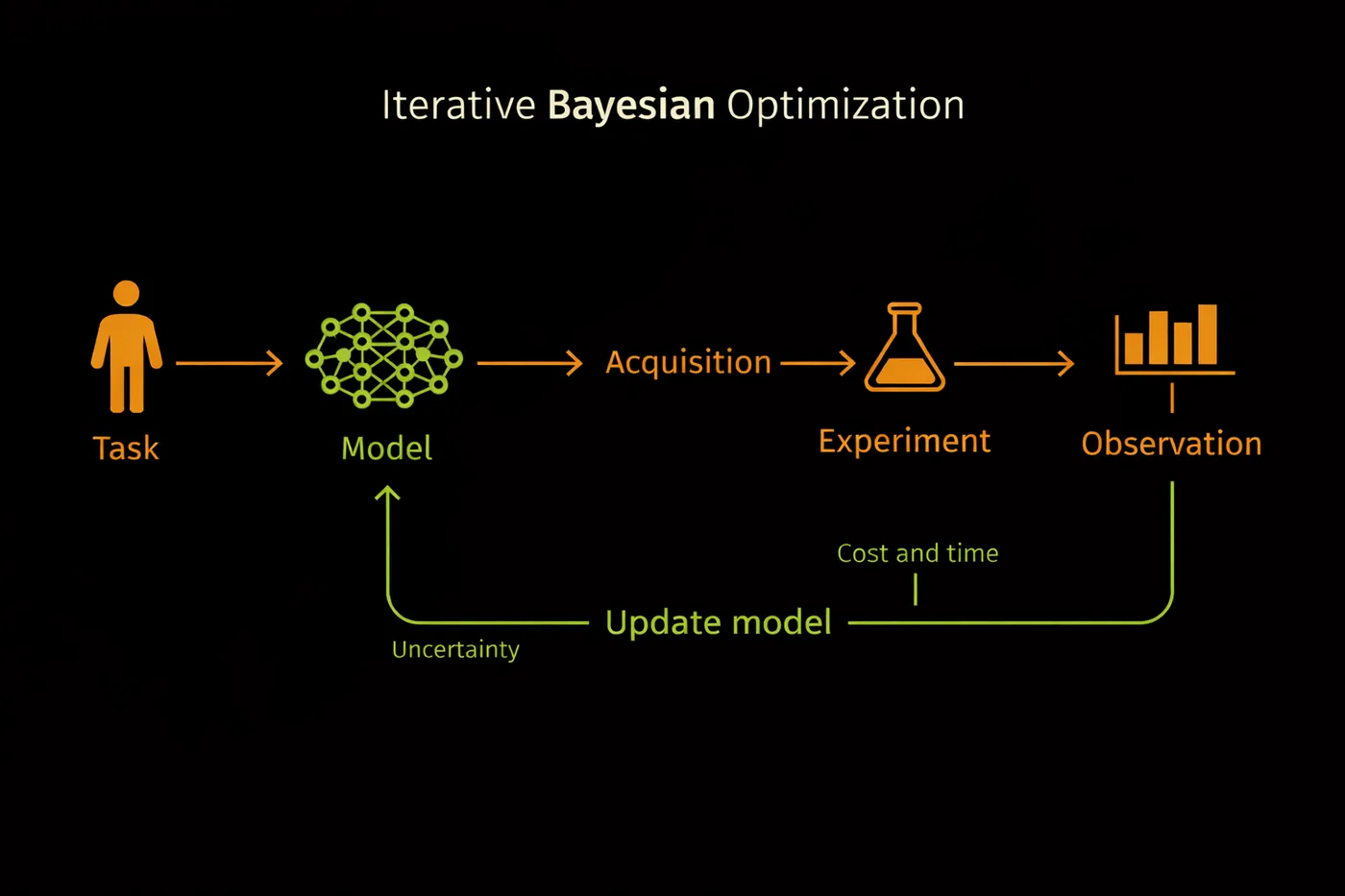
Decide, test, learn, repeat
Trying every option is slow. Bayesian optimization runs a short loop: after each result it picks the one experiment worth doing next, reaching a good answer in far fewer tries.
Decide
The model scores every untried option and proposes the one most worth running: high predicted value, high uncertainty, or both.
Test
You run only that one: a lab trial, a full solve, a build. The costly step, spent once per turn.
Learn
The result updates the model and its confidence. What it now understands narrows; what it still guesses about stays wide.
Repeat
Back to decide, better informed. Good designs surface in far fewer runs than a grid or trial and error.
What the model sees each cycle
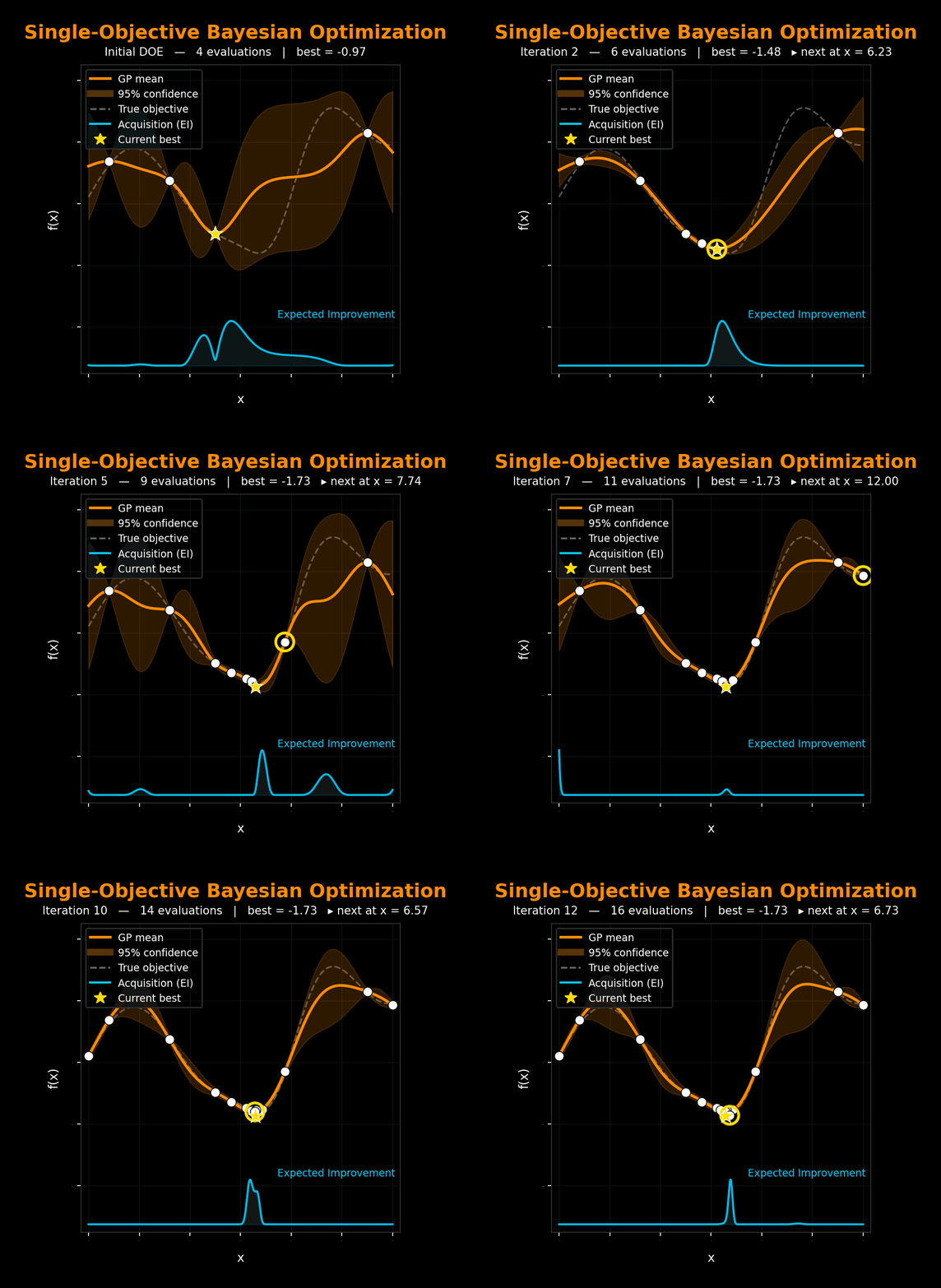
Scroll sideways to read the labels.
The model's current best estimate.
Its uncertainty. Wide where it has no data yet.
Expected improvement: where a new test helps most.
The model picks your next experiment
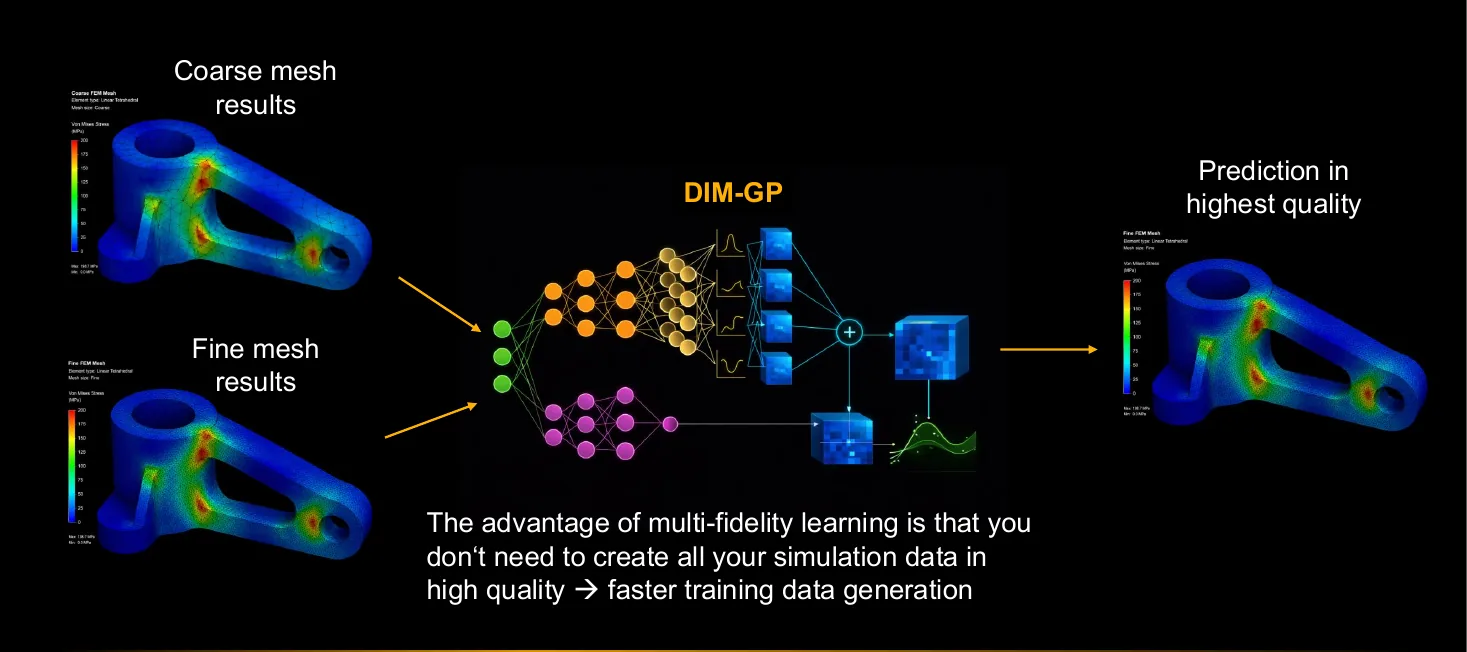
STOCHOS runs this loop with DIM-GP, a probabilistic surrogate for small, noisy data. Its acquisition step balances exploration and exploitation, handles constraints and competing targets, and reports confidence at every turn. PI-BO drives parameters; GEN-BO searches geometry.
Use it where each try is expensive: formulation, process tuning, design, and simulation. It runs on asurrogate model and its uncertainty; for new shapes, see generative design.
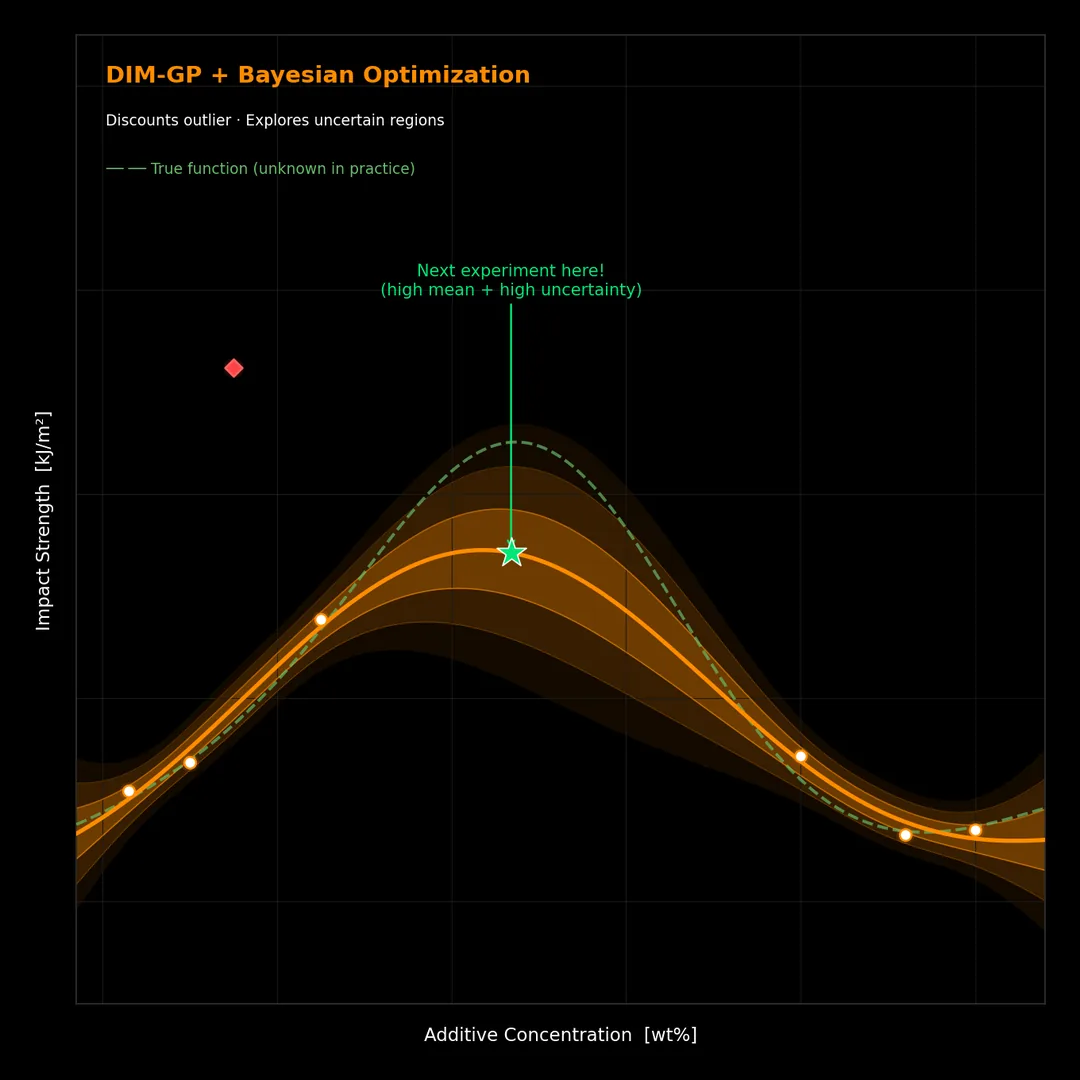
Scroll sideways to read the labels.
- Bayesian optimization for engineersReach a better design in tens of runs, not hundreds.
- Run fewer experiments, learn morePlan the campaign around what each run tells you.
- AI for Chemical R&DWhere this fits in experiments, formulation, and scale-up.
- ZF benchmark at the NAFEMS seminarPI-BO benchmarked by a named industrial user.
- The science behind STOCHOSThe research the method is built on.
Lock in your best settings over a few tries, then let the optimizer work the same problem. Try it against yourself
ZF Friedrichshafen benchmarked PI-BO against adaptive sampling and Latin hypercube designs, presented at a NAFEMS seminar on AI and machine learning in CAE-based simulation. Read the benchmark
Common questions
01When is Bayesian optimization better than design of experiments?
When evaluations are expensive and you can run them in sequence. Classical design of experiments commits to a plan upfront, while Bayesian optimization updates after each result and chooses the next run adaptively. For large spaces and costly trials, the adaptive approach usually reaches the target with fewer experiments.
02Can Bayesian optimization handle several objectives at once?
Yes. STOCHOS supports multi-objective Bayesian optimization, which balances competing targets such as performance, cost, and quality and shows the trade-off between them, rather than optimizing one target while ignoring the others.
03What is Bayesian optimization?
Bayesian optimization finds good designs or settings in as few evaluations as possible. It uses a probabilistic surrogate to decide which point to try next, balancing promising regions against uncertain ones. It suits expensive experiments and simulations where every run costs time or money.
04How many experiments does Bayesian optimization need?
In a typical STOCHOS loop about 5 experiments reach the optimum, where trial and error takes about 30. How many you need depends on the number of parameters, the noise in the measurement, and how tight the constraints are.
05Can I describe an optimization goal in plain language?
Yes, in STOCHOS Flow. Describe the goal in a sentence and the Workflow Agent builds the objective and the constraints for you to check before anything runs. The optimization itself is still STOCHOS, a DIM-GP surrogate proposing the next point to test.