


Why the loop is the cost
The pigments are cheap and the measurement is fast, but each correction is another batch, another cleanup, and another slot on a busy lab schedule. A shade that takes seven passes has not consumed seven times the material. It has consumed a week.
The cost sits in the sequence, not in the ingredients. That makes the number of passes the only lever worth pulling, and it makes the first proposed recipe the most valuable one in the run.
What the model learns from your recipe history
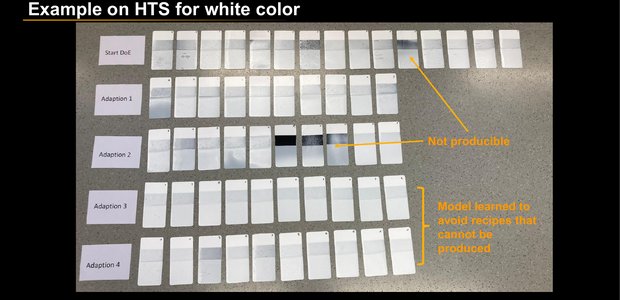
Past formulations and their measured results are training data, so the model learns how your specific pigment set behaves rather than a generic color theory. That includes the awkward parts: which pigments drift in combination, which corrections tend to overshoot, and which recipes your plant cannot actually produce.
It also treats limited, expensive data as the normal case rather than a problem to apologize for, and reports how confident it is in every proposal. A suggestion that sits outside what your history covers arrives labelled as such, which is what Bayesian Optimization then uses to pick the next correction.
The first proposed recipe lands close
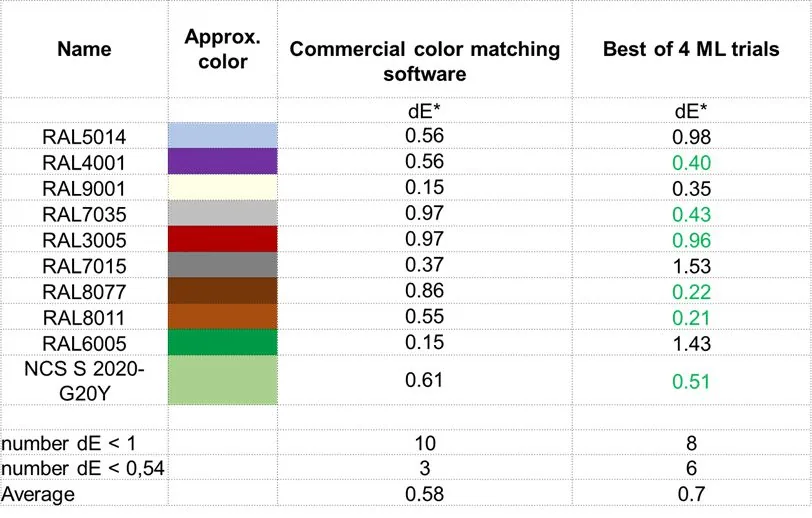
Color difference (delta E) on the first proposed recipe, against about 1.4 before. Illustrative example with its own setup.
Batches to match, against seven before. Hours rather than days. Same illustrative run, same setup.
In a coatings scenario the first proposed recipe landed at a color difference of about delta E 0.6, against about 1.4 before, and the match took two batches rather than seven, hours rather than days. One coatings example under its own conditions, not a promise for every shade.
The number to watch is not the delta E on its own, it is how fast it falls. A first proposal that starts close leaves less to correct, and each measured result then narrows the next step instead of restarting the guesswork.
The spectrophotometer stays, the next recipe changes
The spectrophotometer and the mixing process do not change. What changes is which recipe you mix next. The model reads the measurements you already take and returns a formulation in the same terms your lab already works in.
Constraints you already work under, raw material bounds, cost ceilings, regulatory limits, sit inside the search rather than being applied as a filter afterwards. Nobody has to learn a new instrument to use it, and the same approach carries across the rest of paint and coatings development.
Common questions
01Do I need to re-measure my whole archive?
No. STOCHOS learns from the recipes and measurements you already have. More history helps, but the model is built for limited, expensive data, so you can start with the history you have.
02What about metallics and effect pigments?
Those are harder because appearance depends on the measurement geometry. The STOCHOS approach still applies, and the honest answer is that it needs your data to say how well.
03Can STOCHOS respect constraints like cost or VOC limits?
Yes. Bounds on raw materials, cost, or regulatory limits enter the optimization as constraints on the search, not afterthoughts, so every candidate recipe the model proposes already respects them.
Bayesian Optimization
How each measured result chooses the next experiment to run.
AI for Paint and Coatings
Formulation development with fewer trials, across the full property set.
STOCHOS
The predictive engine: fast predictions with quantified uncertainty.
News and Guides
Project write-ups, releases, and the rest of the guide series.
Nine formulation levers, five targets, and a cost line. Try it by hand before the model does. Take the paint case