

A deterministic fit believes every point
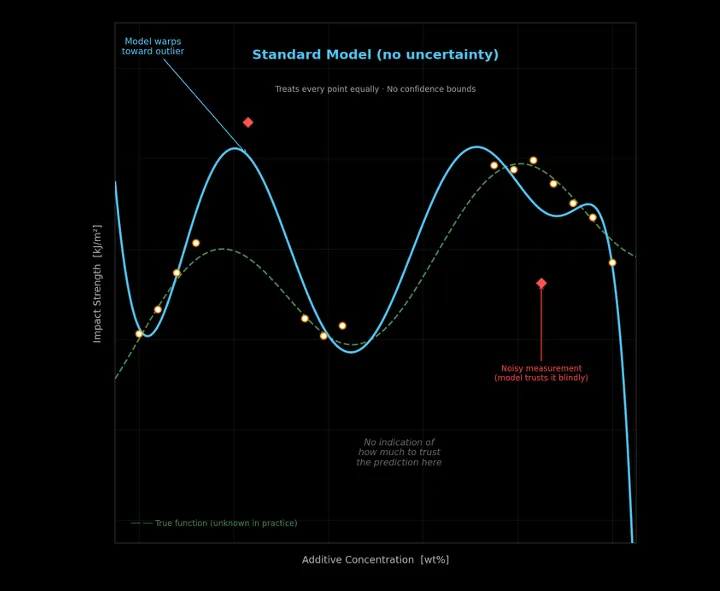
A deterministic fit treats every training point as equally true. One suspect measurement, a mistyped value or a noisy reading, pulls the whole curve toward it, and the model still reports a single number per prediction with nothing attached to say how far to trust it.
A confidently wrong answer is the expensive kind. The error surfaces only after you have acted on it, and a decision built on a warped fit can take months to unwind.
What a probabilistic fit does differently
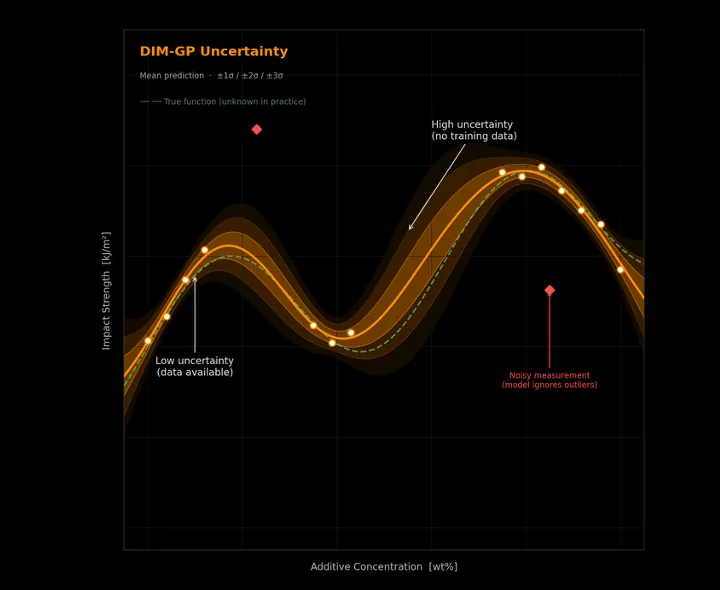
DIM-GP, the probabilistic engine inside STOCHOS, is designed for small, noisy datasets without manual tuning. Every prediction comes back as a mean with 1, 2, and 3 sigma bands around it.
Treats every training point as equally true.
Bends toward a suspect measurement.
Returns one number per prediction.
Reports the same confidence everywhere, data or no data.
Treats every training point as one noisy measurement.
Keeps a suspected outlier from dominating the fit.
Returns a mean plus 1, 2, and 3 sigma bands.
Widens the bands wherever the data runs out.
Read the bands as a map of data coverage: narrow where training points sit densely, wide where the model is extrapolating and a result needs validation first. The uncertainty quantification page covers how the bands are computed and used.
Common questions
01Does a narrow band guarantee the prediction is right?
No. The bands quantify the model's confidence given the data it was trained on. Inside well-covered regions that is a strong signal. Outside them, a prediction still needs validation against a measurement or a solver run before you rely on it.
02Do wide bands mean the model is bad?
Wide bands mean the model is honest about a region it has not seen. They tell you where to measure or simulate next, and adding data there narrows them. A model that hides that gap is the one to worry about.
03Do I have to tune anything to get the bands?
There is nothing to tune. DIM-GP is designed for small, noisy datasets without manual tuning, and the mean and the bands come out of the same fit. Uncertainty arrives with every prediction, not as an extra step you switch on.
Uncertainty Quantification
The method page: how the bands are computed and what they tell you.
How STOCHOS works
The DIM-GP model behind every prediction, explained.
When to trust an AI prediction
The decision side: when to sign off on a prediction and when to go back to the solver.
News and Guides
Every guide and insight we have published, in one place.