

One noisy measurement can aim the next run at the wrong place
Seven results in, the grid still wants its remaining cells filled. The useful question has changed: which single setting deserves run eight. That decision hangs on how the model treats a measurement it should not fully trust.
The question after seven runs
The first results rule regions out and hint at a slope. An adaptive campaign has to decide, from those few points, where the next one will say the most.
What a deterministic pick gets wrong
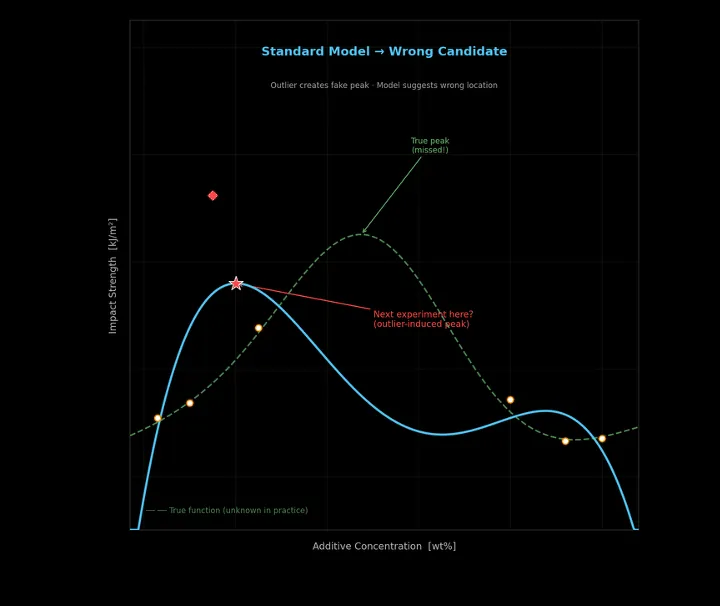
A deterministic model treats every measurement as exact. One noisy value becomes a fake peak, and the next experiment gets aimed at a place the process never reached.
How mean plus uncertainty picks differently
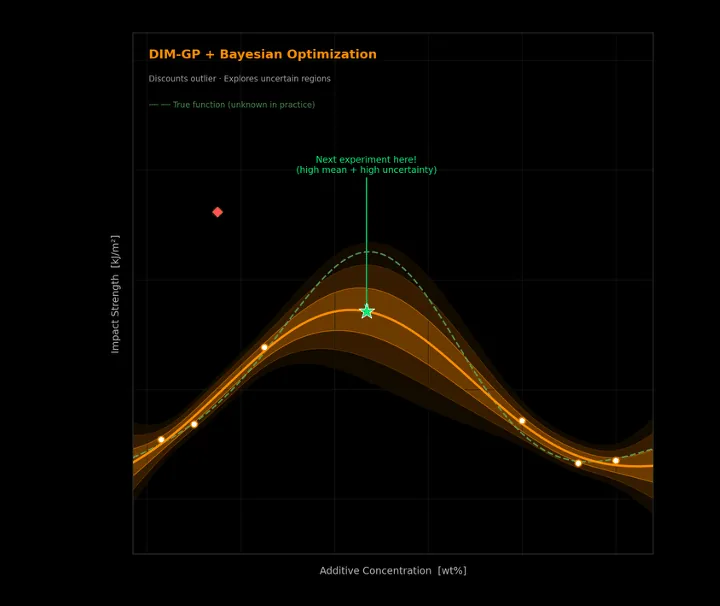
A probabilistic model (DIM-GP) returns a predicted value with a confidence band, discounts a lone point that disagrees with its neighbors, and lets Bayesian optimization target settings where predicted value and uncertainty are both high.
The two picks diverge most near the current best, which is exactly where a wasted run hurts. How the acquisition step trades predicted value against uncertainty is covered on the Bayesian Optimization method page.
A plain-language rule becomes a constraint you can check
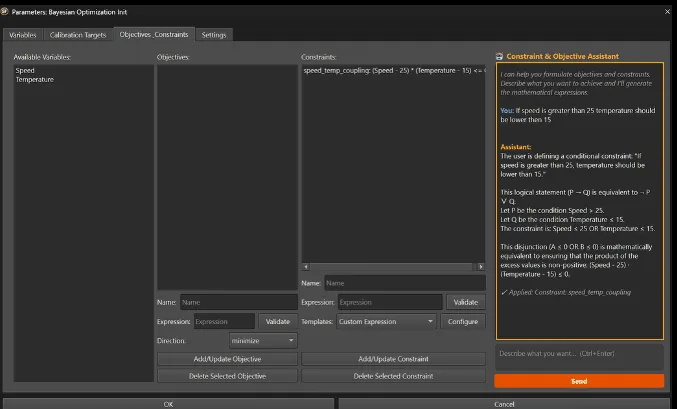
Real campaigns carry rules the optimizer has to respect. In STOCHOS Flow, you state one in plain language, "if speed is above 25, temperature must stay below 15", and the Constraint and Objective Assistant turns it into a validated constraint expression. The expression is there to be read and checked before it is applied.
The division of labour stays clean. The assistant translates and validates the rule; it does not model, predict, or optimize. DIM-GP fits the probabilistic model, and Bayesian optimization selects the next point within the constraint.
Common questions
01How does the model know a measurement is noise and not a real effect?
It does not label points: it weighs them. A probabilistic model fits a distribution, so a lone value that disagrees with its neighbors gets a wide band rather than full trust. If repeat measurements confirm it, the band tightens and the region is taken seriously.
02What if my measurements are precise and noise is not the problem?
The picking rule still applies. With little noise the bands shrink around your data, and the next point is driven by where the model is still uncertain, which is exactly where a fixed grid keeps spending runs.
03Do I have to trust the assistant's constraint expression?
No. The Constraint and Objective Assistant produces an expression you read and check before it is applied. It translates your rule into syntax; the modelling and the next-point selection stay with the engine.
Bayesian Optimization
The method page: how the acquisition step turns predictions and uncertainty into the next run.
STOCHOS Flow
The workflow layer, and the assistant that writes constraint expressions from plain language.
Bayesian optimization for engineers
The full walkthrough: seeding, the loop, and what two example campaigns took.
News and Guides
The full list, from method guides to short insights like this one.
Fewer runs is easier to see than to read. Try three use cases