

Guide

Predict a full field, not a single number

Most surrogate models return one number, so a design that passes on peak temperature still hides where the heat is. A field-capable model predicts the whole distribution across the geometry, not a summary of it, so you get the map in seconds and can see the gradient, the hot spot, and the margin at every point.

This guide covers what a scalar answer costs you, what a field model actually returns, what the timings looked like in two examples, and how the prediction slots into the post-processing you already run.

Request a Demo Surrogate Modeling
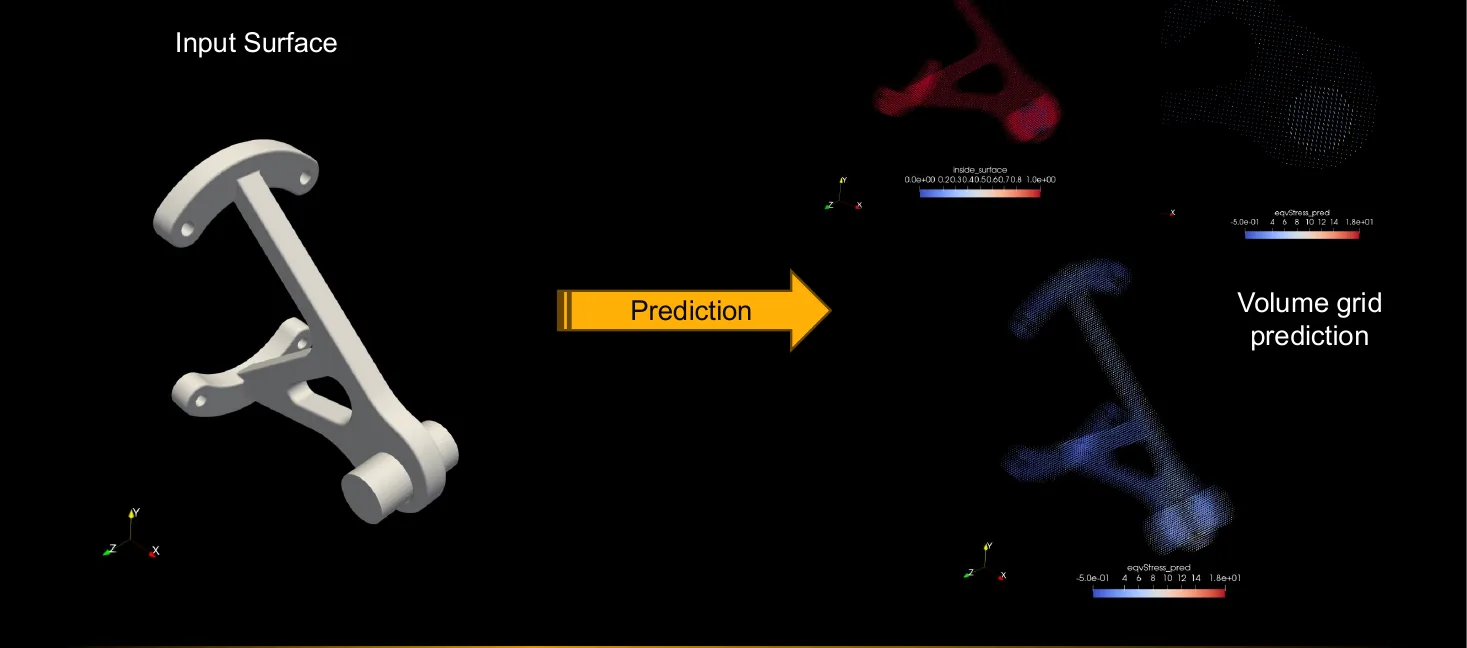
An engineering field prediction: from an input bracket surface geometry STOCHOS predicts the full volumetric von Mises stress field, shown as a colored volume grid prediction.
One input geometry in, a value at every point of the volume out. The prediction has the same shape as the solve it was learned from.
Scalar or field
One number back

What a scalar answer costs you

Peak stress passes or fails a design, but it does not tell you whether the peak sits in a fillet you can redesign or in a wall thickness you cannot.

Two variants can report the same maximum and still need completely different fixes, and the scalar has no way to separate them. So the number gets checked, then the solve gets rerun anyway to see the picture behind it. The summary is cheap to store and expensive to act on.

The whole distribution back

What a field model predicts

The output is the same shape as the solver's, a value at every node or cell, so the prediction can be viewed, sliced, and compared the way a solve is.

You keep the gradient across the part, not only its highest point, so you can see where load or heat concentrates and how far the margin extends around it. Because the shapes match, the difference between a prediction and a reference solve is itself a field you can inspect. STOCHOS is not a physics solver, it learns the mapping from solves you have already run.

Where

The location of the peak, not only its size.

How steep

The gradient around it, which decides whether a fix is local or structural.

How sure

A confidence range that varies across the geometry.
Two timings

The map arrives in seconds

In an engineering scenario a full temperature field came out in about 4 seconds, from about six hours of CFD, and in a pin-fin cooling reference example STOCHOS predicted temperature and heat flux for a new design in under 5 seconds. Each timing comes from its own case setup, so read neither as a general promise.

The number worth taking from those two is not the exact second count, it is what the cost change does to the question you can ask. When a field costs seconds instead of an afternoon, you stop rationing which variants get one. You can look at the map for every candidate in a sweep rather than for the two the schedule allowed, and the ones that look wrong get thrown out before they reach the solver queue.

~4 s

Full temperature field in an engineering scenario, from about six hours of CFD.

<5 s

Temperature and heat flux for a new design in a pin-fin cooling reference example.

Read the caveat

Each figure belongs to its own case setup. Yours is settled by a first look at your data, not by these numbers.

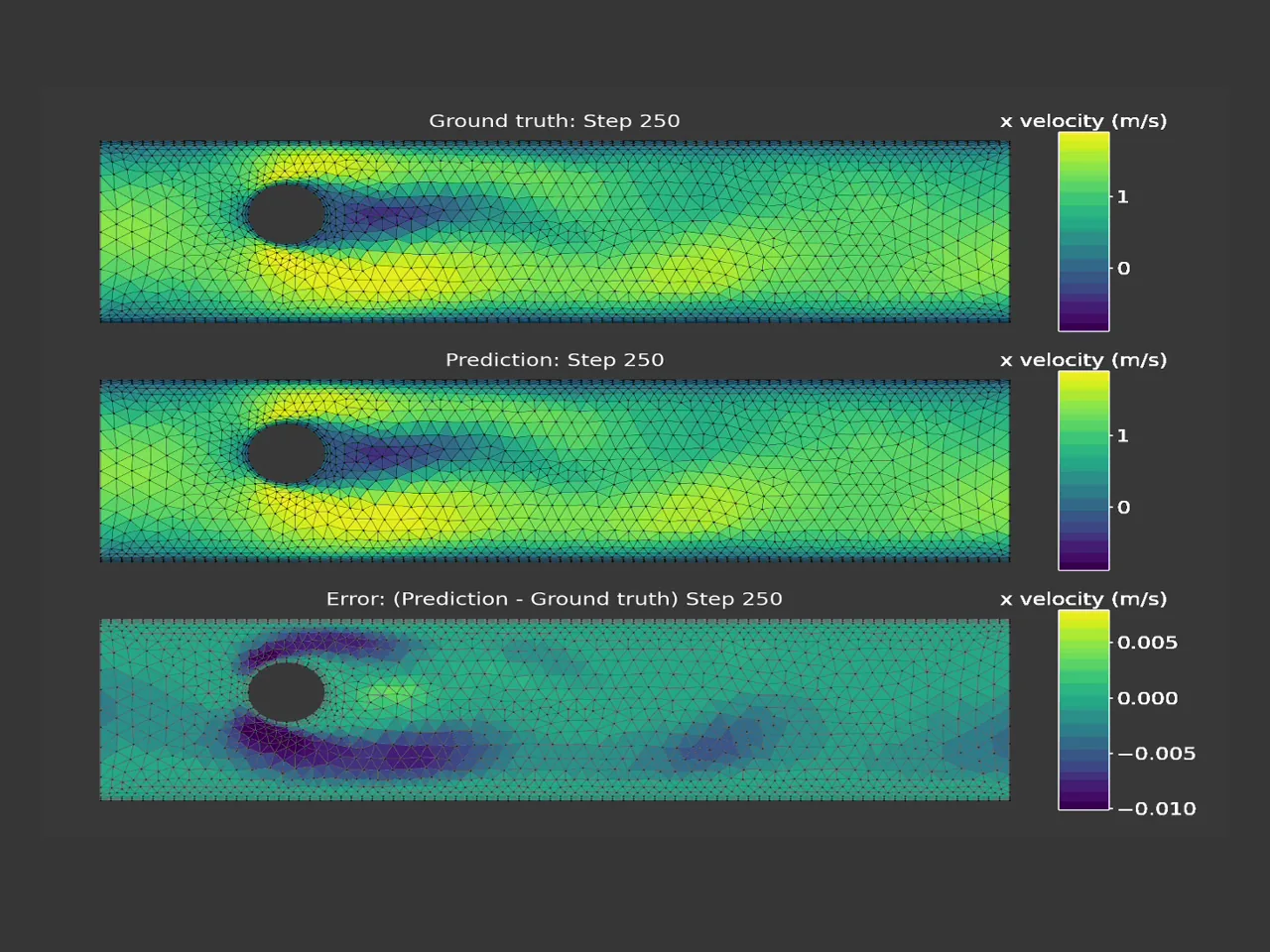
Three stacked velocity color maps of flow past a cylinder: the CFD solver ground truth, the STOCHOS surrogate prediction of the same field, and their near-zero difference.
Solve, prediction, and the difference between them. When outputs share a shape, the check is a picture rather than a spreadsheet.
In your toolchain

Predicted fields land in your post-processor

The field prediction goes into the same post-processing you already use, and the solver still validates the designs that matter.

Nothing about the toolchain has to change. You screen many variants against predicted fields, shortlist the few that hold up, and send those through the solver exactly as before. The surrogate model is trained on solves you have already paid for, so it extends that spend instead of replacing it. Where the model is less certain the range widens, and that is your cue to spend a solve there first. More on the engineering side of this is on AI for Engineering.

Common questions

01Does STOCHOS need identical meshes across runs?

Consistency helps. The practical answer depends on your case setup, which is what a first look at your data settles.

02Do I get uncertainty on the field too?

Yes. The confidence range is spatial as well, so you can see where in the geometry the model is less sure.

03Does field prediction replace CFD or FEA?

No. It predicts new variants fast from the solves you have already run, and the solver validates the shortlist.

Related pages
Method

Surrogate Modeling

What a surrogate learns from your solves, and when it is worth training one.

Method

Uncertainty Quantification

Why a prediction should come with a range, and how to read it across a geometry.

Solution

AI for Engineering

Where prediction sits alongside CFD, FEM, and CAE in a working process.

Index

News and Guides

The rest of the guides, plus what we have published recently.
Next step

Send us a field you want predicted

Bring one case you have already solved. A first look at your data settles the questions this page can only answer in general: mesh setup, how many solves you need, and what the confidence range looks like on your geometry.

Request a Demo How STOCHOS works

Local-first. Your data stays on your infrastructure.

Partners, customers, and research collaborators
AnsysCADFEMSimuTech GroupMEScoTSNEBoschZFGEMUDLRAdler LackeMankiewiczDuluxPlixxentFraunhoferHochschule NiederrheinFUELL Lab AutomationHumotionUniversitaet HamburgRobert Bosch Stiftung