

Why scale-up is where projects die
Every scale you move up changes mixing, heat transfer, and residence time, so the model that fitted the bench does not describe the reactor.
The formulation did not change, but the conditions it meets did, and effects that were negligible in a flask can dominate in a vessel. That is why a result which looked settled in the lab reopens at plant scale, and why the answer usually arrives in the form of a failed qualification batch.
It is more useful to treat bench, pilot, and plant as three different systems that happen to share a recipe, and to ask what each one is actually good for.
Bench
Fast and repeatable, so you can afford many runs. It gives you the shape of the response: which inputs matter, and in which direction.
Pilot
Fewer runs, conditions closer to production. This is where the bench picture starts to bend, and where the size of the correction becomes visible.
Plant
Expensive, slow to schedule, and the only scale that answers the question you actually need answered. You get very few of these.
What multi-fidelity means here
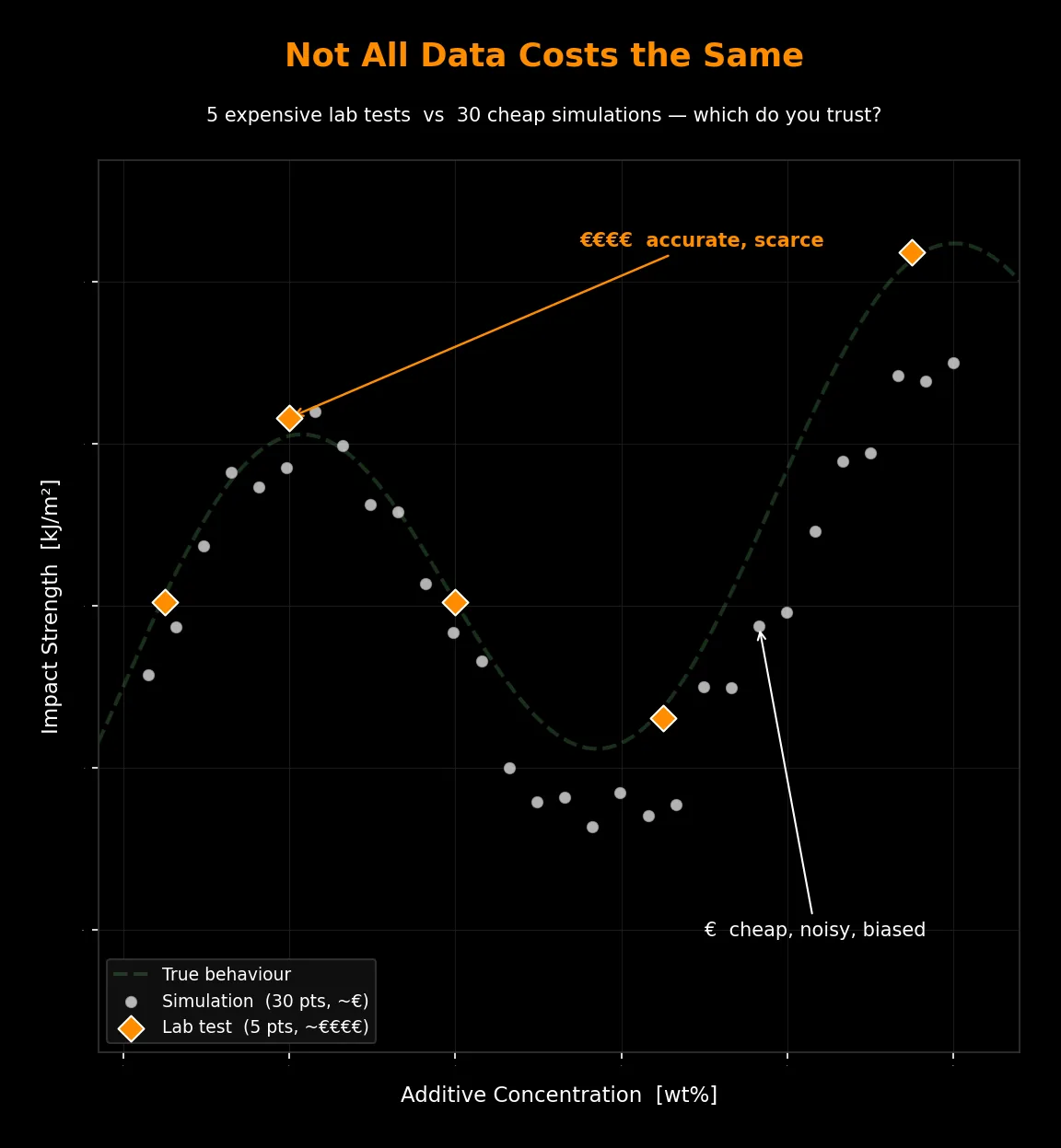
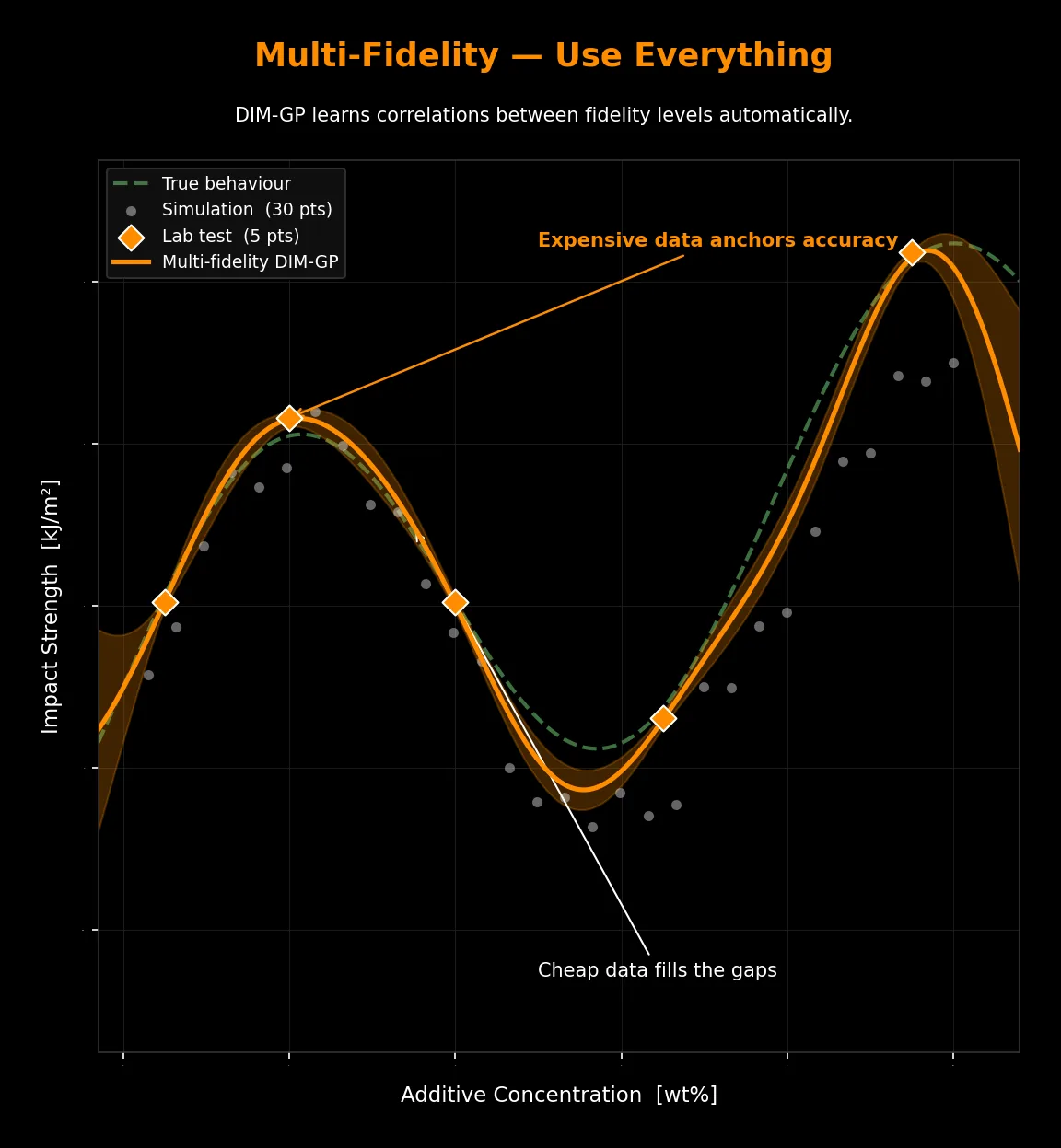
Rather than discarding cheap data, the model uses it for the overall trend and uses the handful of expensive runs to learn the offset between scales.
The cheap runs are treated as informative but biased, so the model keeps their structure and corrects their level. The expensive runs are treated as accurate but scarce, so they anchor that correction instead of carrying the whole fit on their own.
What comes out is one model across both sources, with a confidence range that reflects how much full-scale evidence stands behind each prediction. Multi-Fidelity Modeling goes through the mechanics.
The training set is already in your records
It uses the bench and pilot data you already generate, so the change is which run you choose next, not how you run it.
There is no new instrumentation and no separate data programme. The runs already sitting in your records are the training set, and each new result updates the model as the campaign proceeds.
The wider picture for process work sits on AI for Chemical R&D.
Common questions
01How many full-scale runs do I need?
Few, which is the point. In multi-fidelity modeling the cheap lab and pilot data carry the trend and the few expensive full-scale runs carry the correction. The exact count depends on how far apart the scales behave.
02Does multi-fidelity modeling replace pilot plant work?
No. The model tells you which pilot runs are worth doing and what to expect from them, so pilot time goes into the runs that reduce the most risk.
03Can STOCHOS combine mixed data sources?
Yes. Combining sources of different cost and accuracy is what multi-fidelity modeling is for. Lab measurements, pilot data, and simulations can feed one model of the same process.