

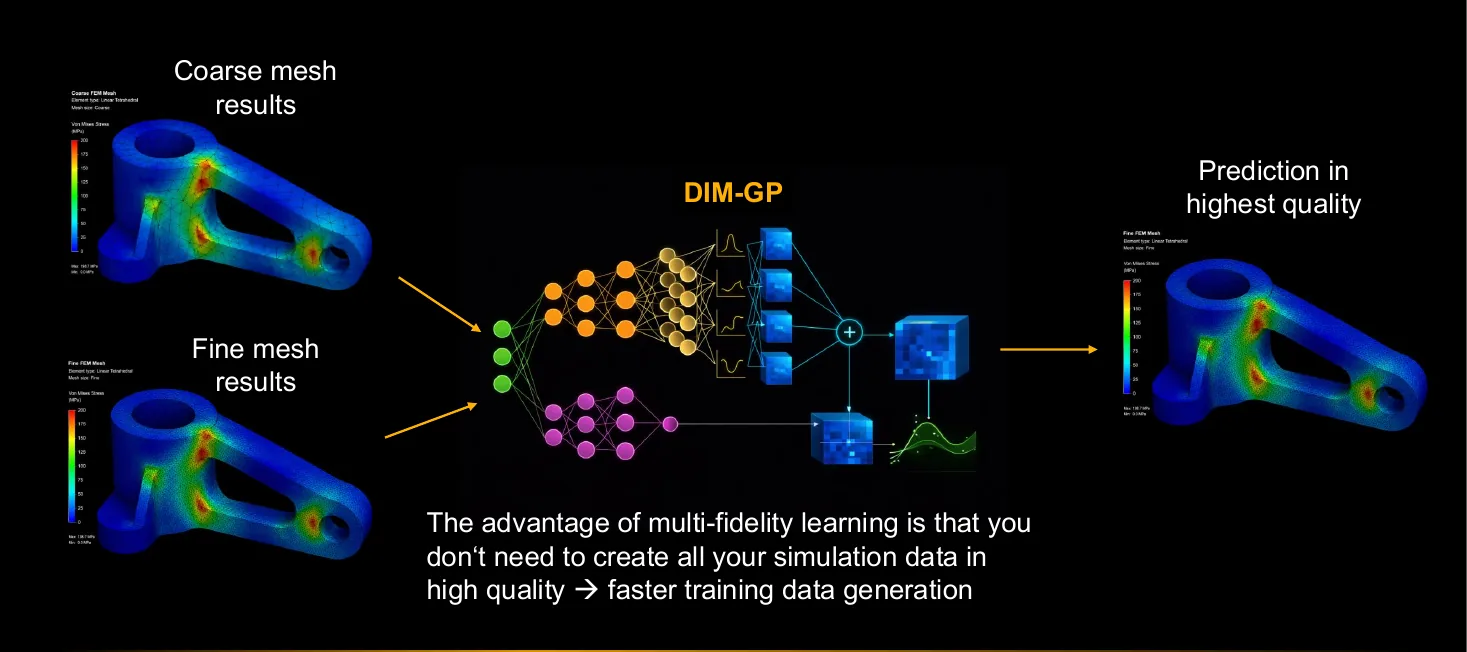
Cheap data covers the space. Accurate data gets it right.
Follow one example the whole way down: how an additive changes a material's impact strength. Same question, two kinds of data, one model that uses both.
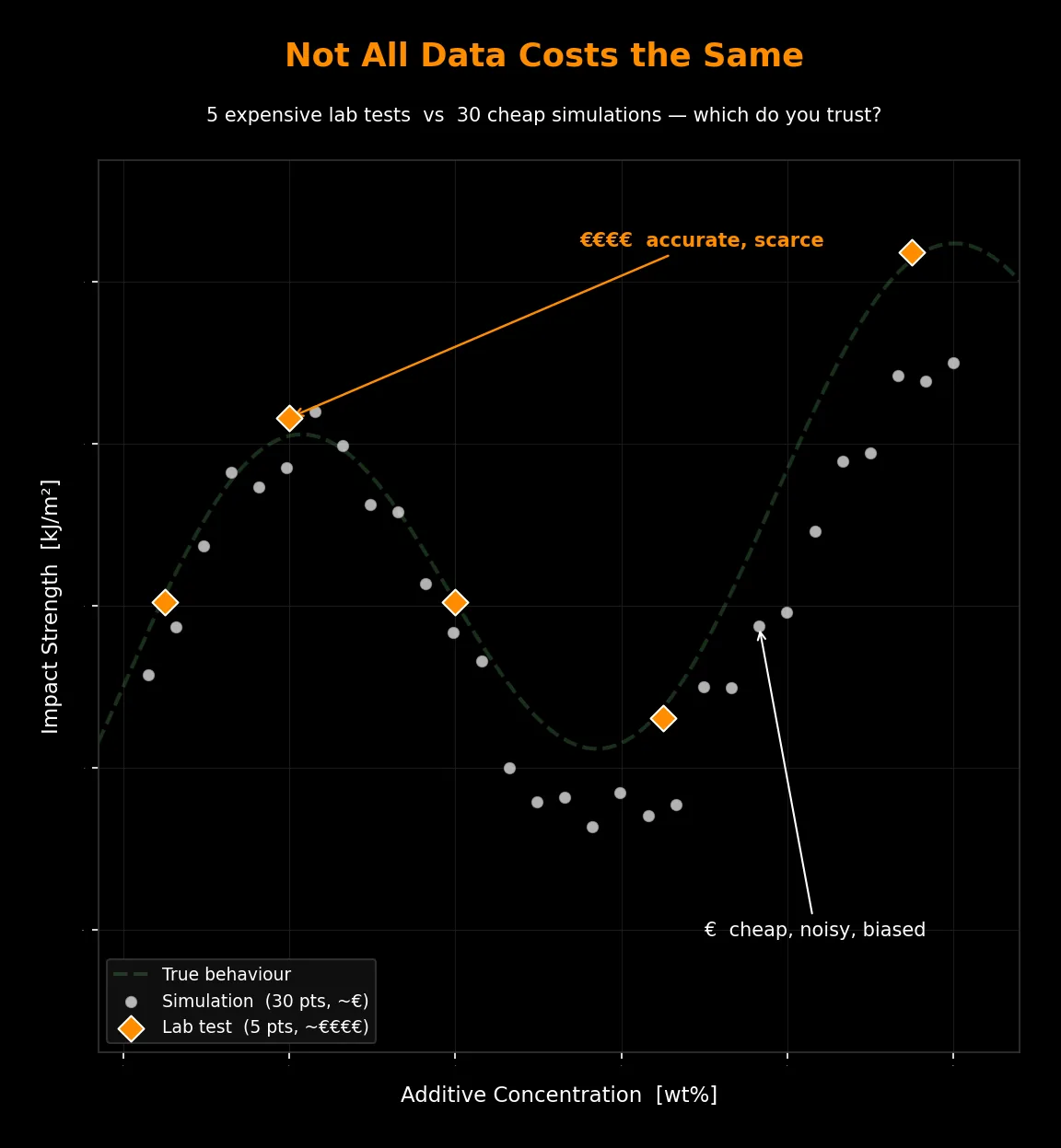
Not all data costs the same
Lab tests are accurate but slow, so you run five. Simulations are rough but cheap, so you run thirty. Two views of the same curve, at very different prices.
Scroll sideways to read the labels.
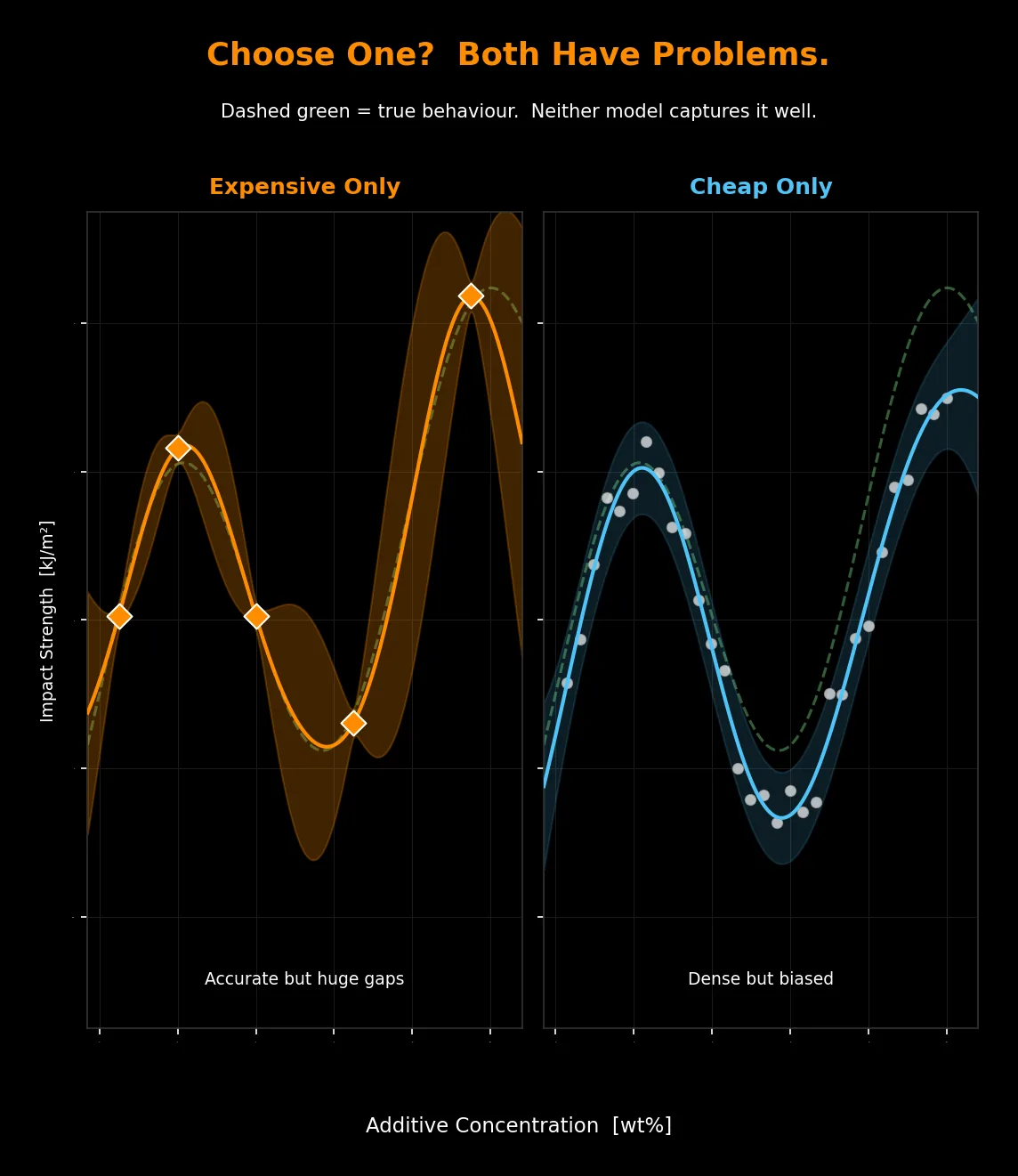
Pick one and you lose something
Use only the accurate points and you are right where you measured, blind in between. Use only the cheap points and you cover everything but drift off the truth. Neither source is enough alone.
Scroll sideways to read the labels.
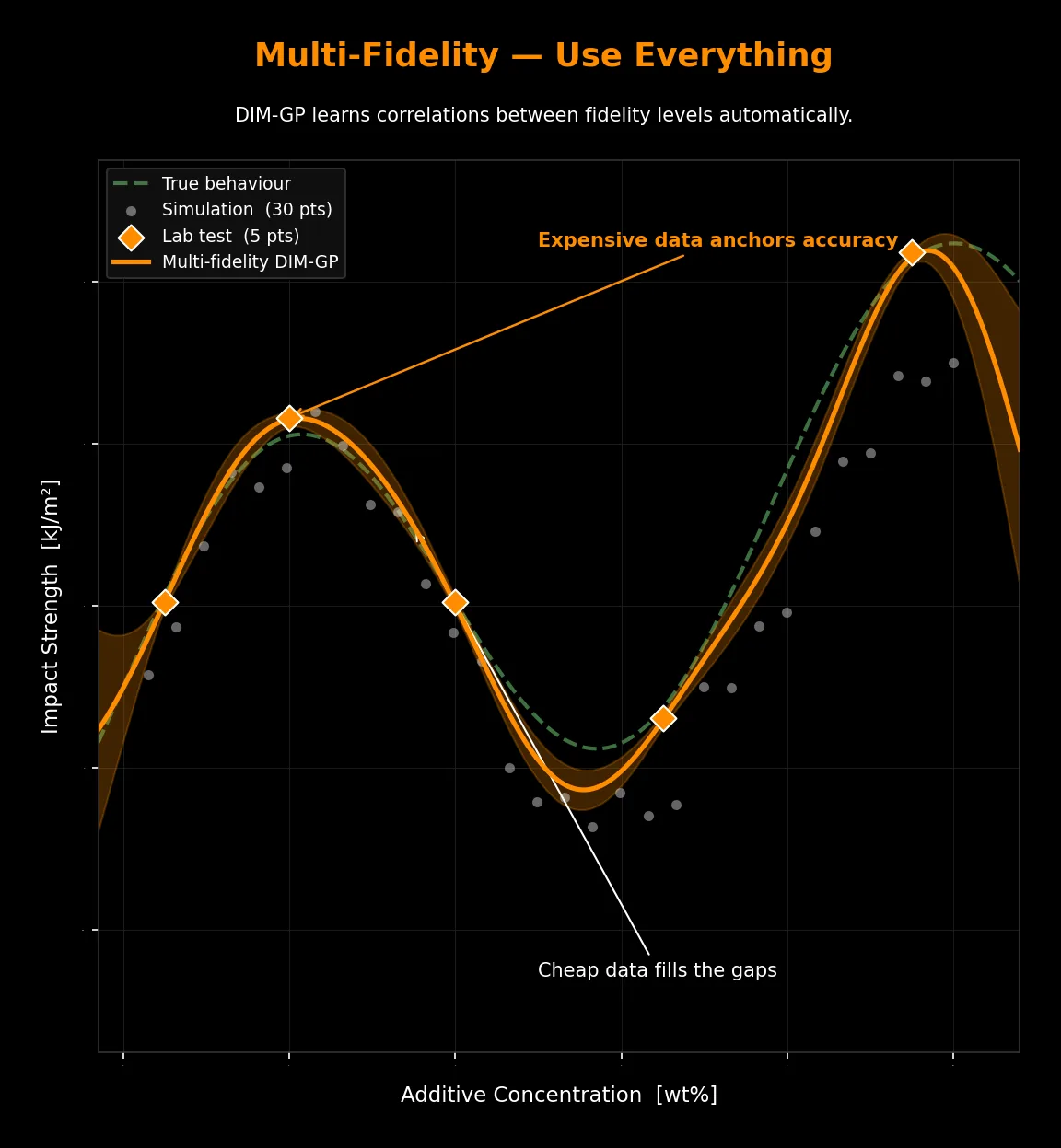
Combine them in one model
A multi-fidelity model learns how the two sources relate. The few accurate points anchor the answer; the many cheap points fill the space between them. One prediction across the whole range, with a band that widens where evidence is thin.
Scroll sideways to read the labels.
Built into the model, not bolted on
STOCHOS learns how the fidelity levels relate inside one probabilistic model, the DIM-GP, and reports confidence everywhere. There is no separate, hand-tuned pipeline. The same approach spans coarse and fine simulation, simulation and experiment, or lab and production.
Multi-fidelity is a surrogate model that spends your data budget where uncertainty says it counts.
Liquid-state measurements are cheaper than dried-film tests, and lab data is cheaper than production data. A multi-fidelity model predicts final properties from both, without running every expensive test.
Fewer expensive tests for the same accuracy.
Savings depend on how closely the cheap source tracks the expensive one.
- Combine cheap and expensive dataA few costly runs alongside many cheap ones.
- Cut lab to production scale-up riskUse small-scale data to predict the plant result.
- AI for Chemical R&DWhere this fits in experiments, formulation, and scale-up.
- Multifidelity analysis of an induction hardening deviceA worked case study, no customer named.
- The science behind STOCHOSThe research the method is built on.
Common questions
01Why not just use the accurate data?
Accurate data is usually expensive and scarce, so on its own it rarely covers the whole range. Multi-fidelity modeling adds cheap, broad data for coverage and uses the accurate data to anchor the answer. You get a better prediction at lower total cost.
02Does multi-fidelity modeling only apply to simulation?
No. The idea works wherever sources differ in cost and accuracy: coarse and fine simulation, simulation and experiment, or lab, pilot, and production. STOCHOS handles these combinations inside one model.
03Can the cheap data make the prediction worse?
Yes. If the cheap source does not track the accurate one, it can mislead the model. That is why the accurate data stays in control: it anchors the answer, and the model reports where confidence is low. You check the combined model against the accurate data alone.
04What is multi-fidelity modeling?
Multi-fidelity modeling combines cheap, lower-accuracy data, such as coarse simulations, with a few expensive, high-accuracy runs. The cheap data covers the design space, the accurate data anchors the prediction, and STOCHOS learns from both in one model, so you get reliable predictions at lower total cost.