

A few inputs carry the result
Change one ingredient in a recipe and the dish barely moves. Change another and it is ruined. Every process is the same: many parameters you could adjust, a few that decide the outcome. Sensitivity analysis finds that few and ranks them.
Coating strength: how much each input moves the result.
Across the whole space, and for one case
A global view ranks what drives the result across the whole space. A local view explains one specific case. STOCHOS produces both from the model it already trained.
Scroll sideways to read the labels.
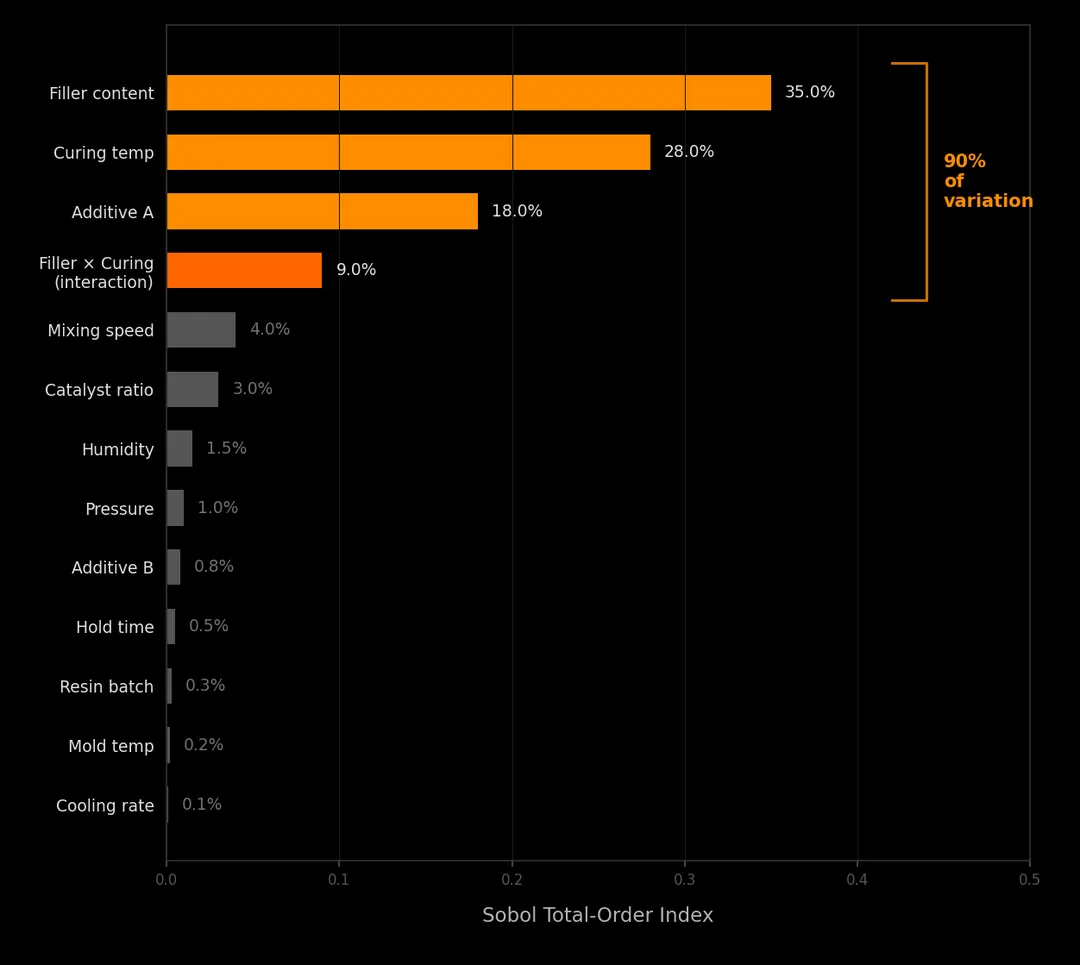
Global view: Sobol indices
A few inputs dominate. The rest can be fixed or ignored.
Scroll sideways to read the labels.
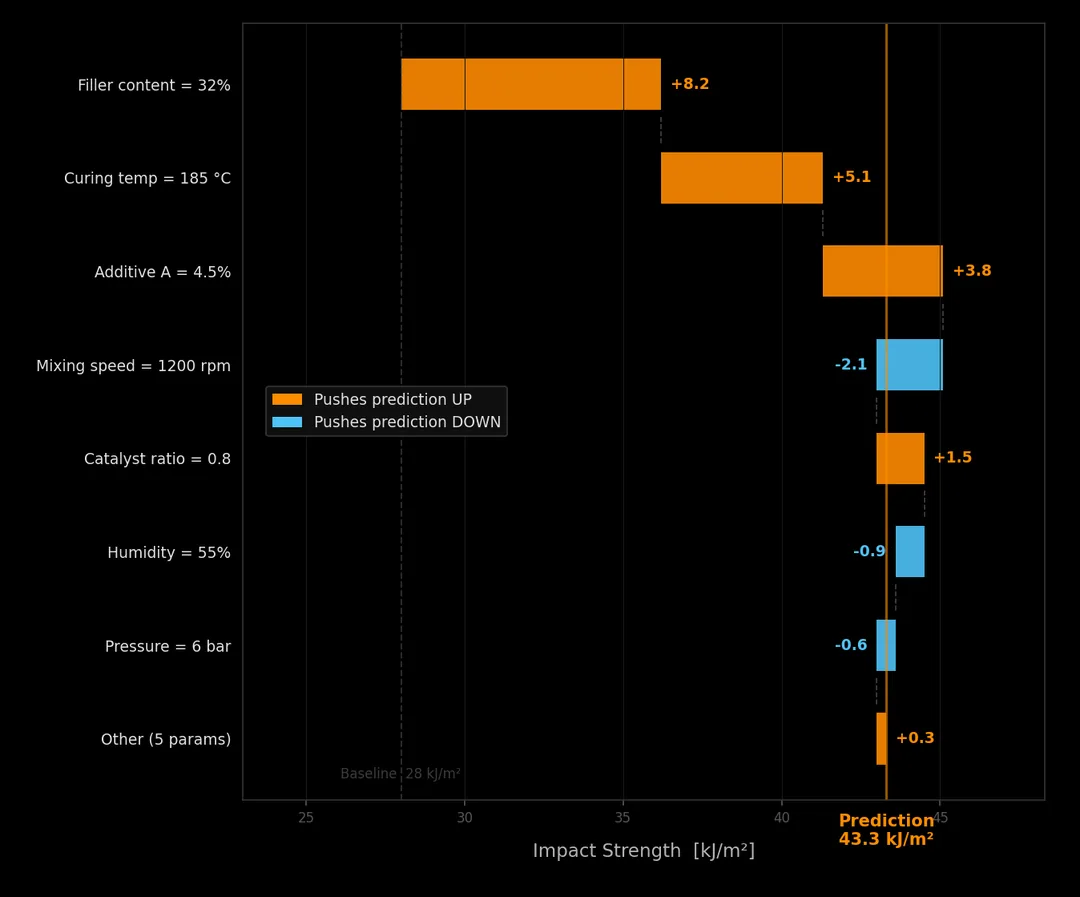
Local view: SHAP
What pushed one specific case up, and what pulled it down.
Four ways to ask what matters
Splits the result's variation across inputs and interactions. For nonlinear effects and interactions.
Explains one prediction. For a single batch, design, or outlier.
Averages gradients to rank many inputs cheaply. For thinning a large parameter set.
Linear or monotonic association. A fast first look; it misses nonlinear effects.
STOCHOS runs all of these. Once you know the drivers, tune them with Bayesian optimization.
Common questions
01What is the difference between Sobol indices and SHAP?
Sobol indices attribute the variance of an output to inputs globally, across the whole space. SHAP explains a single prediction by sharing its value among the inputs. STOCHOS supports both: Sobol for "what drives the result overall" and SHAP for "why did this specific case behave this way."
02Does sensitivity analysis need extra experiments?
No. STOCHOS computes sensitivity on the trained surrogate model, so it reuses the data already gathered and adds no expensive runs. The analysis then guides where new experiments would be most useful.
03What is sensitivity analysis?
Sensitivity analysis identifies which inputs drive an output and which barely matter. STOCHOS computes it from the trained model using methods such as Sobol indices, SHAP, DGSM, and correlation, so you focus testing and optimization on the parameters that actually move the result.
04Can sensitivity analysis show where on a part the response is sensitive?
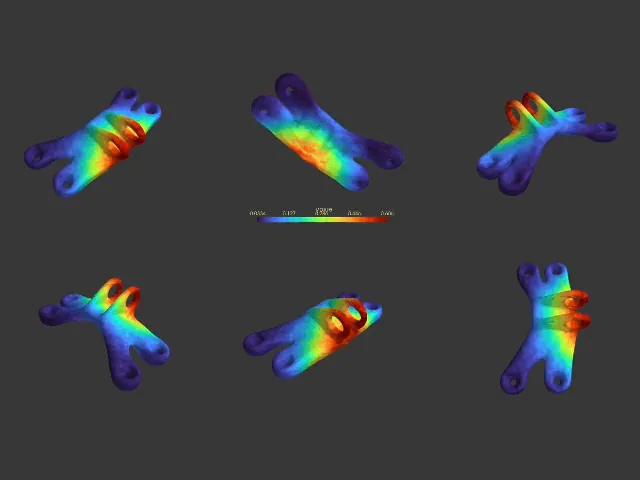
Yes. Alongside global Sobol indices and local SHAP values, STOCHOS computes spatial sensitivity: which region of the geometry responds to a change, not only which input does. That gives you a map on the part rather than a bar chart.