

Show it examples, get new designs
A generator does not score a shape you drew. It makes the shapes. You give it a handful of real designs, it learns the space they share, and it proposes new ones that stay inside it. Generation is not proof: every candidate still needs a performance check and a final solver run before you trust it.
Starts from one block of allowed space and a set of loads. It removes material to leave a single shape that meets a physics goal.
Starts from example shapes you already have. It learns their shared space and proposes many new valid variants for you to choose from.
One returns a single optimized part from physics. The other returns a family of variants learned from your designs.
One example, start to finish
Follow a mounting bracket through generative geometry in STOCHOS, from the designs you feed in to the variants you get back. This is a demonstration example. Real results depend on the geometry, the data, and the objective.
Start from designs you already have
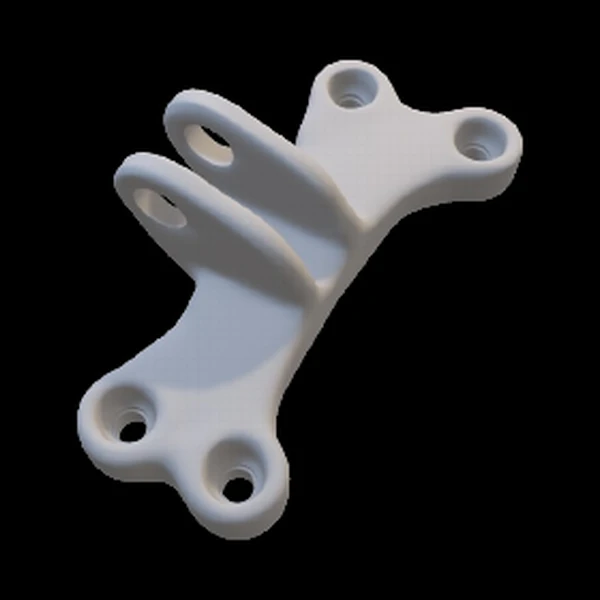
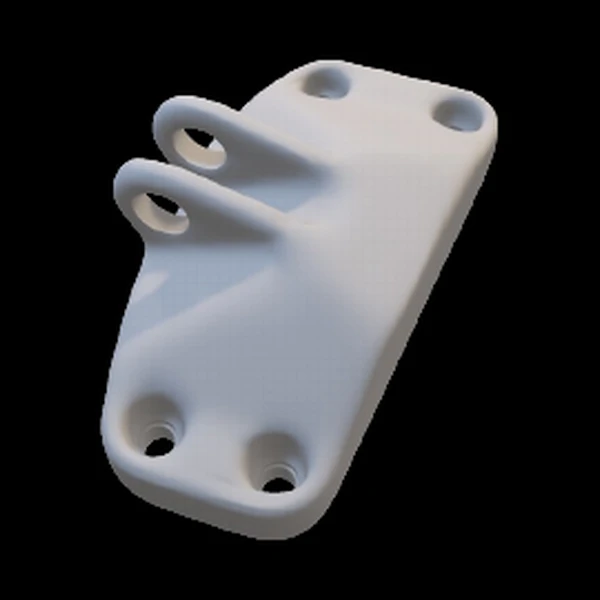
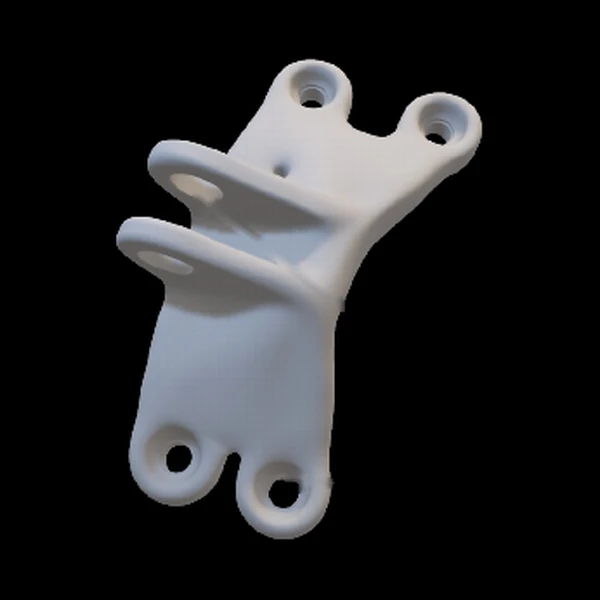
Here, three bracket designs go in. The mounting holes are part of each shape, so the model keeps them as constraints on its own. You do not define them by hand.
The model learns the space
STOCHOS learns what the three designs have in common: the space of shapes they belong to. In this example, training took under a minute on a single GPU. From here, nothing is drawn by hand.
Get new, valid variants in seconds
The model proposes new shapes inside that space, in seconds. Each is a complete geometry, not a rough sketch, and each keeps the holes it needs.
Predict how each performs, then improve
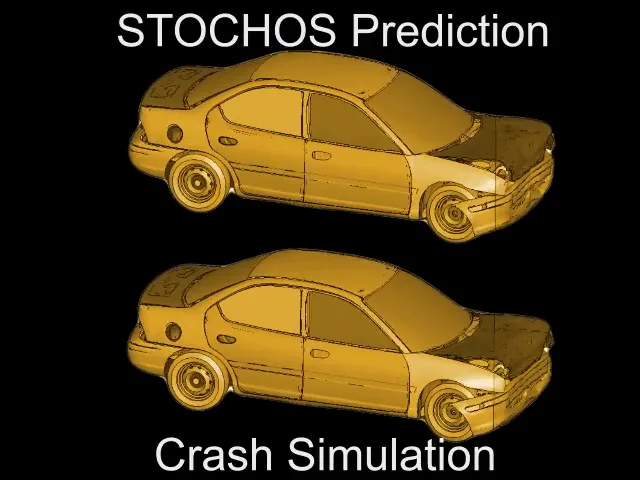
A new shape only helps if you know how it behaves. On each generated design, STOCHOS can predict full fields, stress, temperature, or flow, in seconds, instead of re-running the full solver each time. Rank the variants by predicted performance, then let GEN-BO search for a better shape. Keep the solver for final checks.
How field prediction works →GEN-BO demo: best vertical displacement 0.238 mm after 50 designs, optimized in under 10 minutes. Demonstration example, results depend on the geometry, the data, and the objective.
The same method on other geometry
The walkthrough follows one bracket. The same method runs on a rotating impeller and a vehicle mirror housing.
Common questions
01Is this the same as the generative AI that makes images?
No. Here, generative design means learning the space of engineering shapes, then producing new valid geometries that respect real constraints and ranking them by predicted performance. It works on parts, not pictures or text.
02Is generative design the same as topology optimization?
No. Topology optimization removes material inside a fixed design space to produce one shape that meets a physics goal. The generative geometry here learns from example shapes and proposes many new variants. The two can be combined, but they are different methods.
03How many designs do I need to start?
There is no fixed number. The demonstration on this page used three bracket designs. What you need depends on the geometry, how varied the shapes are, and how far you want the model to explore. Start with what you have, and add designs if the variants come out too narrow.
04How is GEN-BO different from normal optimization?
Classical optimization searches a fixed set of parameters you define up front. GEN-BO generates new geometries as it goes and uses uncertainty-aware Bayesian optimization to choose which to test next, so it explores shapes you did not list while spending few expensive evaluations.
05What is generative design?
Generative design learns the shared structure of existing geometries and generates new, valid variants inside the constraints you set. Instead of improving one design at a time, you search a space of shapes. In STOCHOS, GEN-BO combines this generation with Bayesian optimization to steer the search toward a target.