
The bottleneck moved
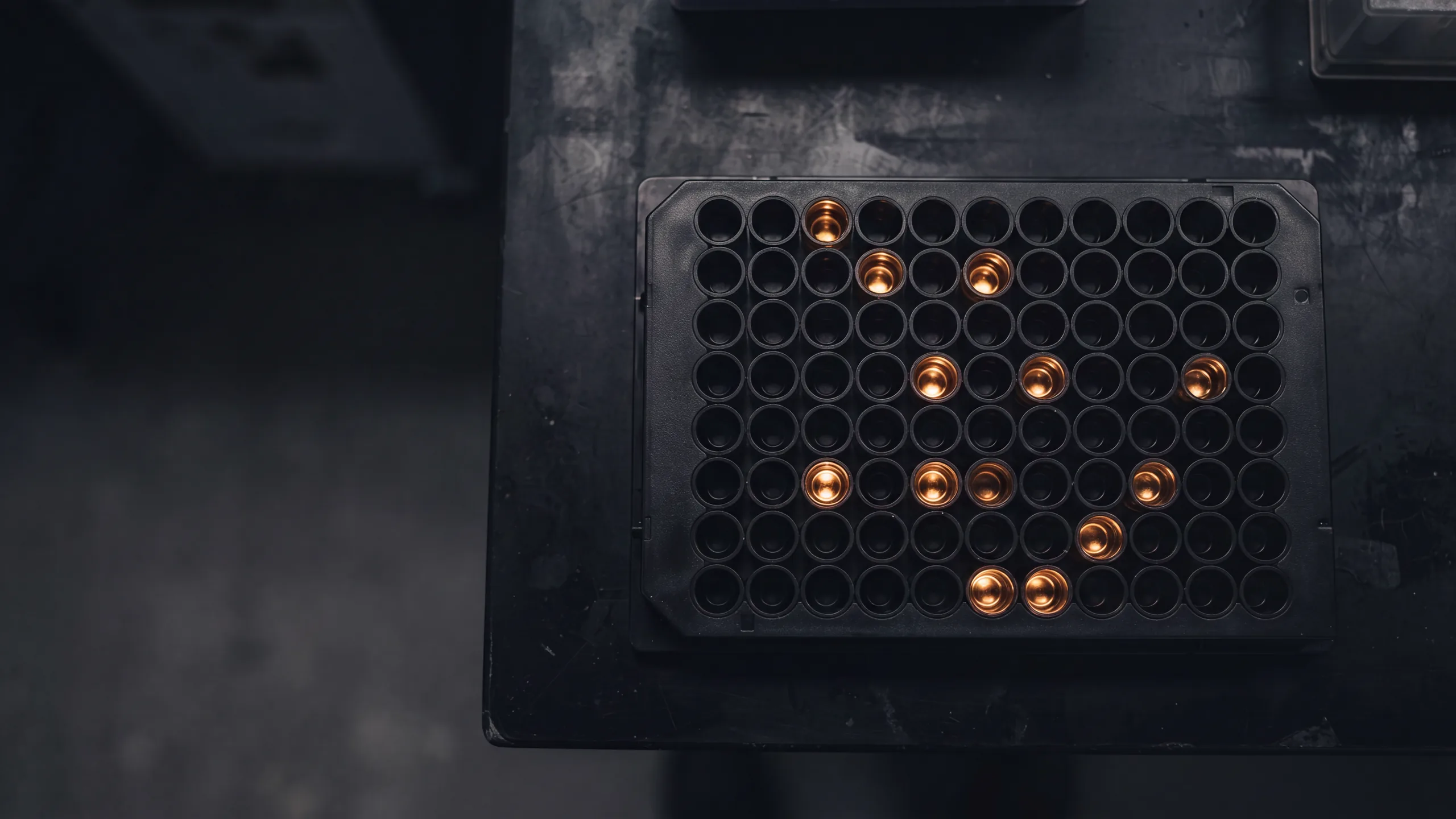
Once the robot runs hundreds of samples a day, the limiting factor is no longer capacity, it is whether those samples were worth running. A liquid handler does not know the difference between an informative formulation and a redundant one, so a plate laid out from a fixed design spends the same time and reagent on both.
The scarce resource is now the attention it takes to decide what goes on the next plate. In most labs that decision is made once, at the start of a campaign, and then executed unchanged for weeks while results accumulate that nobody has time to fold back into the plan.
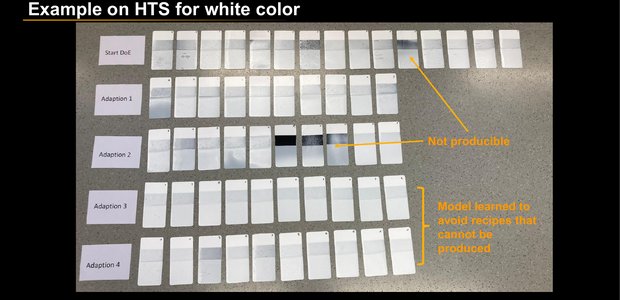
Screening volume against screening well
A full factorial fills the plate with combinations you can predict; choosing by expected information fills it with the ones you cannot. Both plates hold the same number of wells and take the same time to run. They differ only in what you know afterwards.
The plan is fixed before the first result
Every level of every factor gets its share of wells, including the regions the previous plate already settled. Coverage is even across the space, and so is the waste. Results arriving mid-campaign cannot change anything, because the design was committed on day one.
The plan is rebuilt after every plate
Each completed plate retrains the model, and the next set is chosen where the prediction is least certain or most promising. Wells concentrate where the answer is still open, and the regions that are already resolved are left alone.
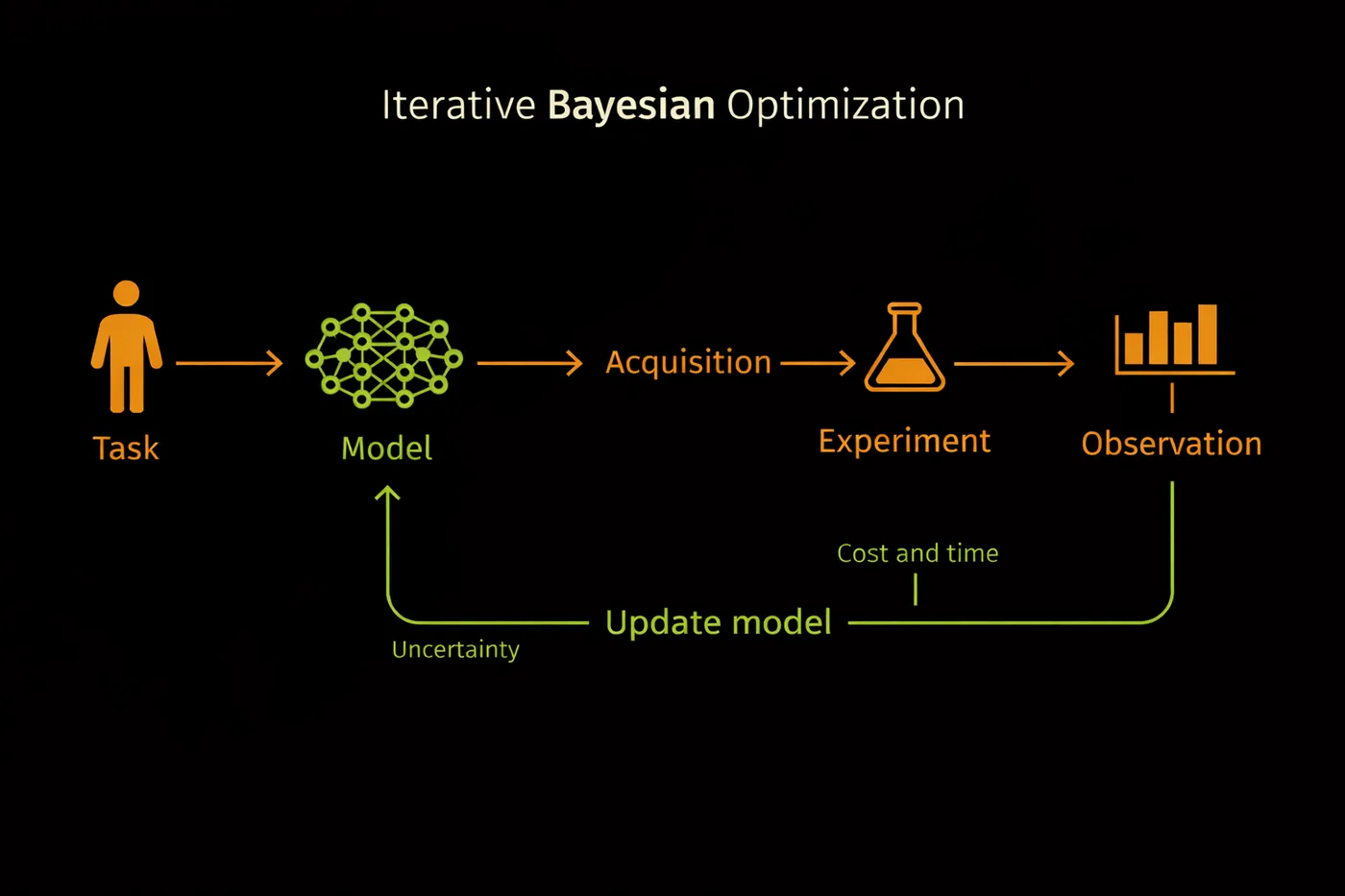
The mechanism behind the second column is Bayesian optimization, applied a plate at a time rather than a sample at a time.
Same equipment, more informative samples
In a chemical scenario the approach reached about 120 informative samples a day, up from about 40, with planning time cut by about half. The figures belong to that setup; your assay and rig will set their own.
Informative samples a day with the model planning the next set.
Informative samples a day before, on the same equipment.
The rig did not get faster. The same hardware produced more usable information because fewer wells were spent confirming what the model already knew, and the planning step stopped being a weekly meeting.
The plate map changes author, not format
The plate map comes out of the model and goes into the same automation you already run, so nothing about execution changes. It is still a list of compositions and settings, in the format your handler expects.
Results come back the way they already do, the model retrains on them, and the next map is proposed before the rig is free. Constraints you cannot break, incompatible pairs, solubility limits, a fixed total volume, are part of the search rather than a manual filter afterwards. You can wire the loop together as a workflow in STOCHOS Flow, or drive it from your own scripts if that is where the pipeline already lives.
Common questions
01Does STOCHOS replace our DoE software?
It replaces the fixed plan, not the discipline. An initial design still seeds the model, and the model decides what comes after it.
02Our assay is noisy. Does that break the model?
No. STOCHOS treats noise explicitly and reports uncertainty with each prediction, which is exactly what a noisy assay needs.
03Can STOCHOS handle mixtures and process settings together?
Yes. Composition and process parameters are just inputs to the same model, and constraints between them are part of the search, so a recipe and its process window are optimized together.
Play the chemistry case and watch the plan tighten with each result. Take the chemistry case