

One smoothness does not fit a real design space
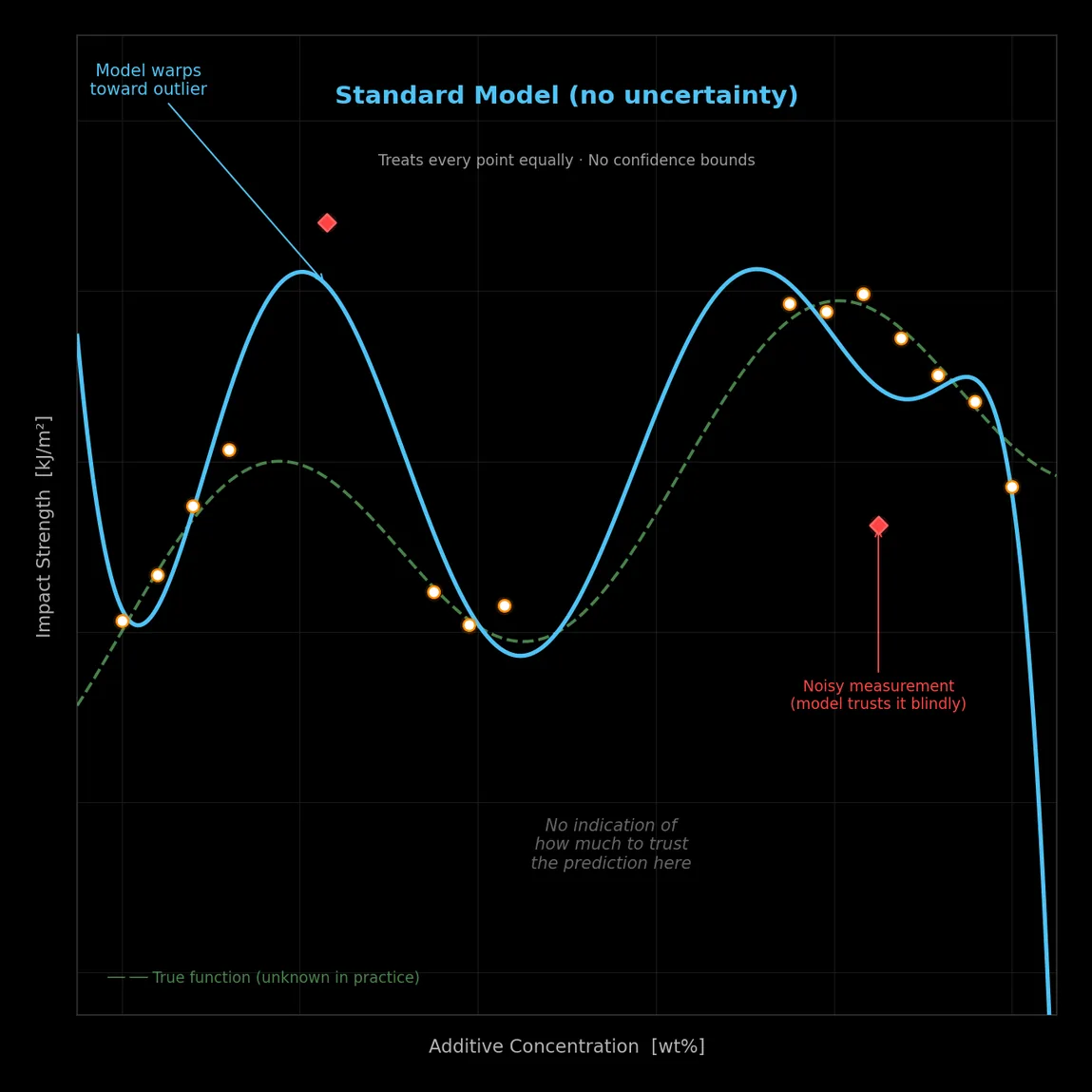
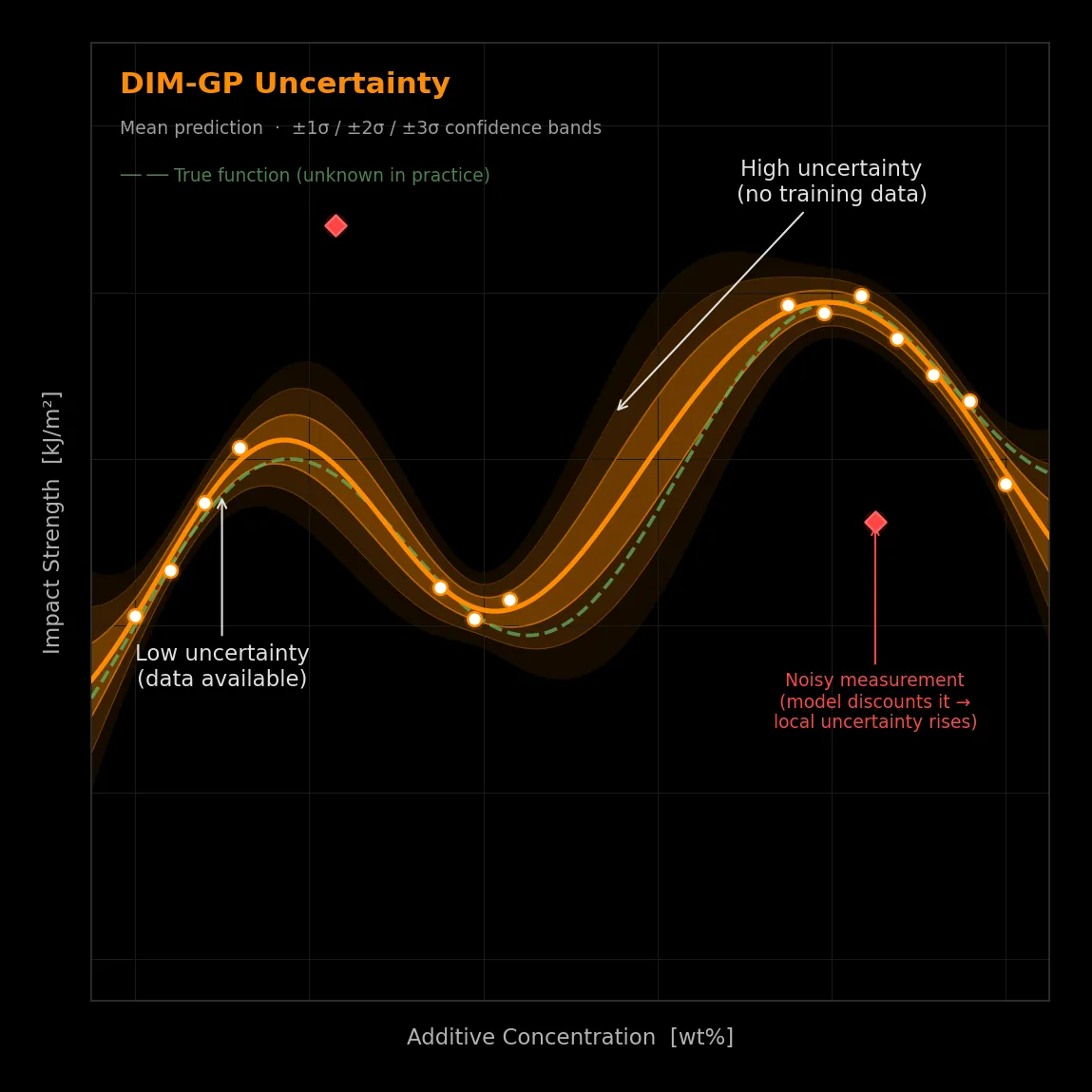
Real responses change character: smooth in one region, sharp in another, densely tested here, barely sampled there. A standard model picks one smoothness for all of it. DIM-GP adapts locally.
Assumes one smoothness everywhere, and slows sharply as data grows.
Scale to complex relationships, but return one number with no confidence.
Learns smoothness and noise locally, and puts a confidence range on every prediction.
It does not chase outliers
Measurements scatter, batches vary, solvers leave numerical noise. DIM-GP learns the noise level point by point, so it separates trend from scatter and does not bend the fit toward an outlier.
Scroll sideways to read the labels.
Scroll sideways to read the labels.
What comes with the model
Built in, not bolted on
Every prediction carries a confidence interval, local to that point. A single accuracy score hides the weak spots.
Built for data that is expensive
When a data point costs hours or money, big-data methods starve. DIM-GP takes the trend a small set of runs supports, and the interval says where the next run should go. Typically 10 to 50 experiments give calibrated error bars: a typical range, not a floor.
Known physics is built in, not fitted
Where the physics is known, it is built into the model rather than fitted from data, so those relations hold by construction. A coarse simulation or physics prior can carry the model while it learns only the correction.
One approach, every data shape
One probabilistic core for scalars, signals, images, 3D fields, meshes, and point clouds, plus multi-fidelity variants. 14 DIM-GP models ship in STOCHOS Flow.
From model to decision
STOCHOS feeds the interval to a Bayesian optimizer that adapts after each result and returns a Pareto front when objectives compete. How Bayesian optimization works
The algorithm is not standing still
New model families, faster training, new data types in regular releases. The team that develops the algorithm is the team you talk to.
Common questions
01What is DIM-GP?
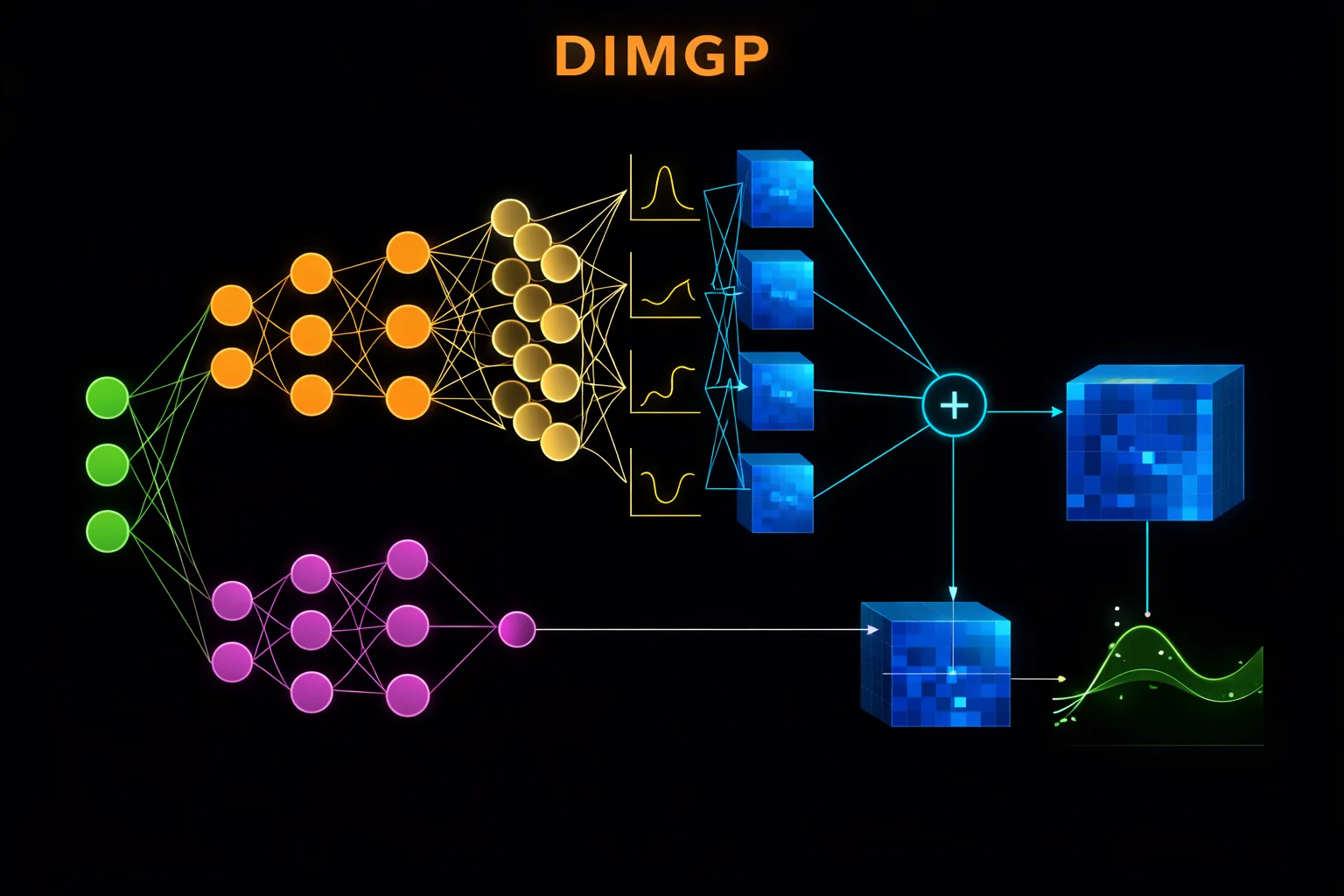
DIM-GP, a Deep Infinite Mixture of Gaussian Processes, is the core STOCHOS algorithm. It combines neural networks and Gaussian processes into a non-stationary, probabilistic model designed for small, noisy datasets, changing geometries and meshes, and multi-fidelity data, without manual hyperparameter tuning.
02Why combine deep learning and Gaussian processes?
Deep learning brings capacity to model complex, high-dimensional relationships. Gaussian processes bring uncertainty estimates. Engineering needs both: a flexible model that also reports how far to trust each prediction. DIM-GP delivers both in one model, and trains several covariance functions at once, letting the data decide which ones carry the model, so the tuning step that normally needs an expert disappears.
03How is DIM-GP different from a standard Gaussian process?
A standard Gaussian process assumes the same smoothness everywhere and becomes slow as datasets grow. In DIM-GP, a deep network sets the process parameters locally, so smoothness and noise adapt across the design space, and training runs in batches, which keeps large datasets practical.
04Can STOCHOS run on-premise?
Yes. STOCHOS runs on Windows and Linux, on CPU or GPU, as a Python 3.12 package built on PyTorch, and can be installed without an internet connection by providing the packages directly. Core modeling and optimization run on your own infrastructure, so sensitive simulation, test, and formulation data stays under your control.