

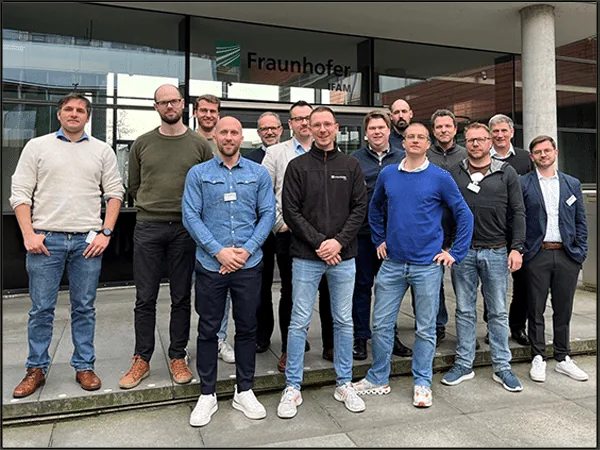
Raw material manufacturers, paint manufacturers, and paint processing companies all collect material and process data continuously. None of it is shared or correlated, and it is not yet clear whether what is collected today even supports valid predictive models. The breadth of the Na, Logisch consortium is what can close that gap.
PI Probaligence and the Niederrhein University of Applied Sciences had already shown the principle worked, optimizing sections of a high-throughput system with AI.
Why paint development needs a digital twin
There is no standardized data exchange along the value chain in paint technology, so the basis for digital technologies is missing or only partly there. Trial and error remains the state of the art in development, production, and processing, and the error half of that is expensive.
- Waste. Paint manufacturers generate between 5 and 30 tons of paint waste a year, depending on production volume.
- Formulations that cannot move. Replacing one raw material in a complex formulation while holding system performance is close to impossible, so the lab work is often never started for lack of R&D hours.
- Lines that stop. In paint processing, the process runs until the finish is right. On complex systems that can take months, and every component produced until then is scrap.
- Regulation. When a paint's properties or composition change, for example under REACH, today's process produces defects and slow manual adjustment of the paint system.
What the project builds
The work package description splits the value chain in two, and the digital paint twin has to span both.
- Value chain 1. Paint formulation and production.
- Value chain 2. Paint application, and how it correlates with the appearance of the painted surface.
The twin is meant to get paint applied with fewer adjustment attempts, and the technologies developed will be made available to German paint manufacturers and the paint-processing industry. Development times drop, renewable raw materials become usable, and processors adjust the painting process from the predictive models instead of from scrap.
It also lays the technical groundwork for sustainable coating raw materials, whose properties fluctuate far more, and for reformulating quickly at benchmark quality when rules such as REACH restrict CMR substances.