

Picking one source means living with its gap
Every team with a simulation and a test rig faces the same trade. The source you trust, a physical test or a fine simulation, arrives a few runs at a time and each one costs real money or real waiting. The source you can afford, a coarse simulation or a fast approximation, produces points by the thousand and every one of them is systematically off. Most teams pick a side and accept the gap: sparse truth with holes between the points, or dense coverage that is wrong at the level.
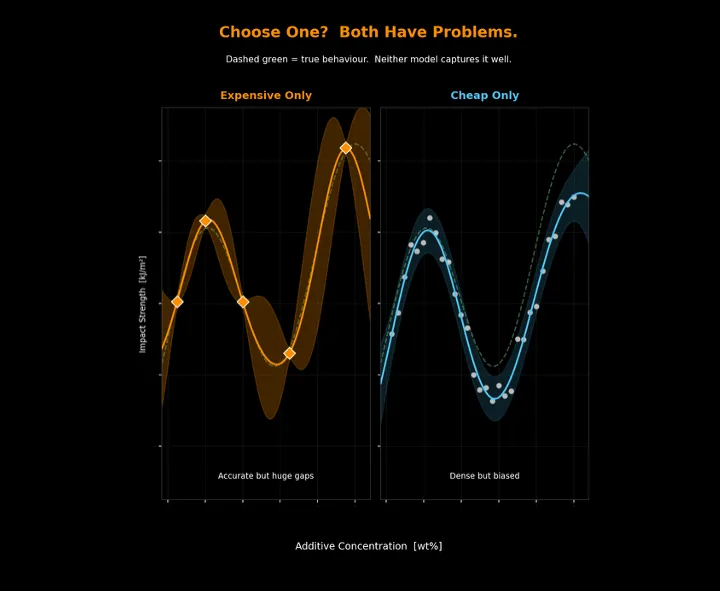
Expensive only
True where you measured, silent in between. A handful of points leaves gaps the model has to guess across, and the guesses are widest exactly where the design gets interesting.
Cheap only
Full coverage with a built-in offset. The trends are usable, the level is not, and nothing inside the data says how far off it sits.
Combined
The dense source carries the shape, the accurate source pins the level, and the model reports where neither has enough evidence to be sure.
One model that knows which source to trust
Multi-fidelity DIM-GP learns the correlation between fidelity levels instead of averaging them. The dense cheap data supplies the shape of the response, the scarce expensive data anchors it to the truth, and a source that turns out to be unreliable is down-weighted rather than trusted blindly. A biased simulation cannot drag the fit away from measurements it disagrees with.
Bayesian optimization can sit on top and decide which fidelity to run next. Where the cheap source can settle a question, the budget stays cheap; an expensive run is proposed only where cheap data cannot answer. How the model is built is on the Multi-Fidelity Modeling page.
Common questions
01What counts as cheap and expensive here?
Any pair of sources that measure the same response at different cost and accuracy: a coarse mesh and a fine one, a fast approximation and a full simulation, a simulation and a physical test. Cost can mean money, compute, or waiting time.
02What happens when the two sources disagree?
Disagreement is information. The model learns how strongly the cheap source correlates with the accurate one, and where that correlation is weak the cheap data is down-weighted rather than trusted blindly. The expensive points remain the anchor.
03Does this replace the expensive tests?
No. The expensive source stays the anchor and the check on every prediction. What changes is where you spend it: the next expensive run goes to a point the cheap data cannot settle, not to one it already covers.
Multi-Fidelity Modeling
The method page: how sources of different cost and accuracy become one model.
How STOCHOS works
The DIM-GP model behind the fit, and why it suits small, noisy datasets.
Cut lab to production scale-up risk
The chemistry version of this idea, applied to lab and plant data.
News and Guides
Every guide and insight we have published, in one place.