Case study · June 4, 2025

Case study: multifidelity analysis of a traversed induction hardening device

PI Probaligence modeled the maximum temperature at three points of a traversed induction hardening device by combining 20 high-fidelity and 69 low-fidelity simulations, keeping high-fidelity accuracy while sharply cutting compute (case study, June 2025).

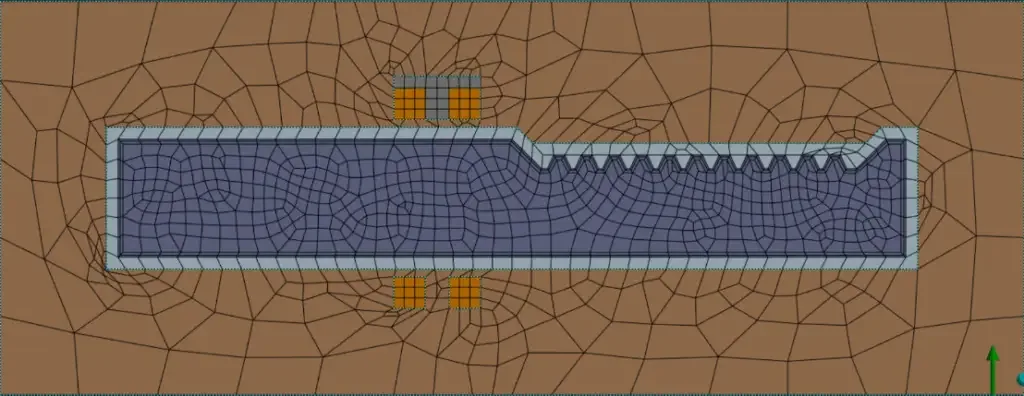
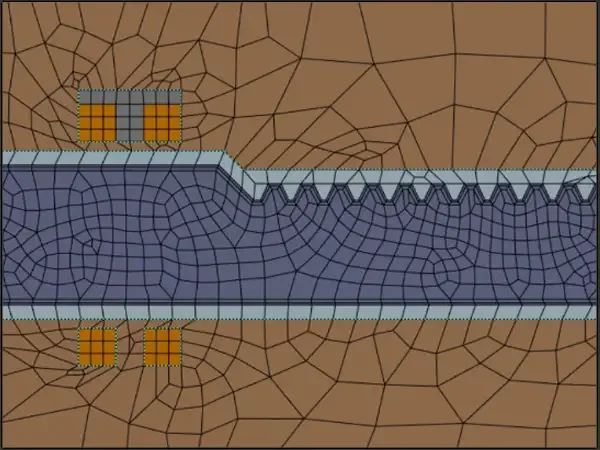
Close-up of the coarse finite element mesh showing the workpiece cross-section and the orange induction coil elements

To model the maximum temperature at three points of interest (POIs) during an inductive process, we faced a classic challenge: achieving high-fidelity accuracy (fine grid and temporal resolution) while minimizing computational effort. Each simulation depends on three parameters across three segments (current, inductor y-offset, and velocity), leading to a complex, high-dimensional design space.

The challenge

A fully high-fidelity model would need a large number of expensive simulations. A purely low-fidelity model is faster and unreliable. Neither one is a real option.

7x
Cost ratio
A high-fidelity simulation is roughly seven times more expensive to compute than its low-fidelity counterpart.
Up to 40%
Error, low fidelity only
Temperature prediction error a direct comparison showed when only low-fidelity data was used.

The solution: multifidelity modeling

Our multifidelity algorithm combined 20 high-fidelity and 69 low-fidelity simulations, 89 samples in total, into one global model that predicts high-fidelity temperature outcomes at all POIs.

How the sampling works

An adaptive design of experiments: start from a small, correlated batch of low- and high-fidelity samples, build a data-driven surrogate, then keep proposing new points where high-fidelity insight is worth the most. Only the essential high-fidelity runs get made.

The results

  • The multifidelity metamodel reproduces the high-fidelity system behavior at an acceptable error rate.
  • A standard machine learning model trained on the same limited high-fidelity dataset performs significantly worse.
  • The approach holds: low-fidelity data explores high-fidelity behavior efficiently and reliably.
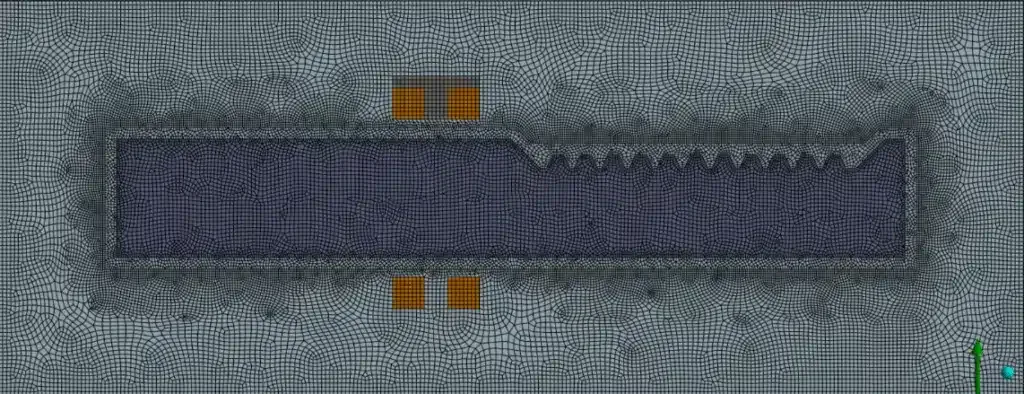
Fine finite element grid of the induction hardening model, with a densely meshed workpiece and surrounding domain
Fine grid (high fidelity)
Coarse finite element grid of the same induction hardening model with far fewer elements
Coarse grid (low fidelity)
Next step
Method
Multi-Fidelity Modeling

Combine cheap and expensive data in one model.

Guide
Combine cheap and expensive data

A few costly runs alongside many cheap ones.

Interactive demo
Try to beat STOCHOS

Three use cases, about two minutes each.

NewerHigh Fidelity Digital Twins Using AI OlderPI at the CADFEM Conference France 2025

← All news and guides

Partners, customers, and research collaborators
AnsysCADFEMSimuTech GroupMEScoTSNEBoschZFGEMUDLRAdler LackeMankiewiczDuluxPlixxentFraunhoferHochschule NiederrheinFUELL Lab AutomationHumotionUniversitaet HamburgRobert Bosch Stiftung