

Why grid search runs out of budget
A five-parameter study at four levels each is 1,024 runs, and every one of them costs solver hours or lab time you do not get back. Most of those runs land in regions the first handful of results already ruled out, so the budget goes on confirming what you know instead of finding what you do not.
Coarsening the grid cuts the count but walks straight past a narrow optimum. Adding a parameter multiplies the whole thing again. The limit is not the size of the space, it is that a fixed plan cannot use anything it learns while it runs.
How Bayesian optimization chooses the next run
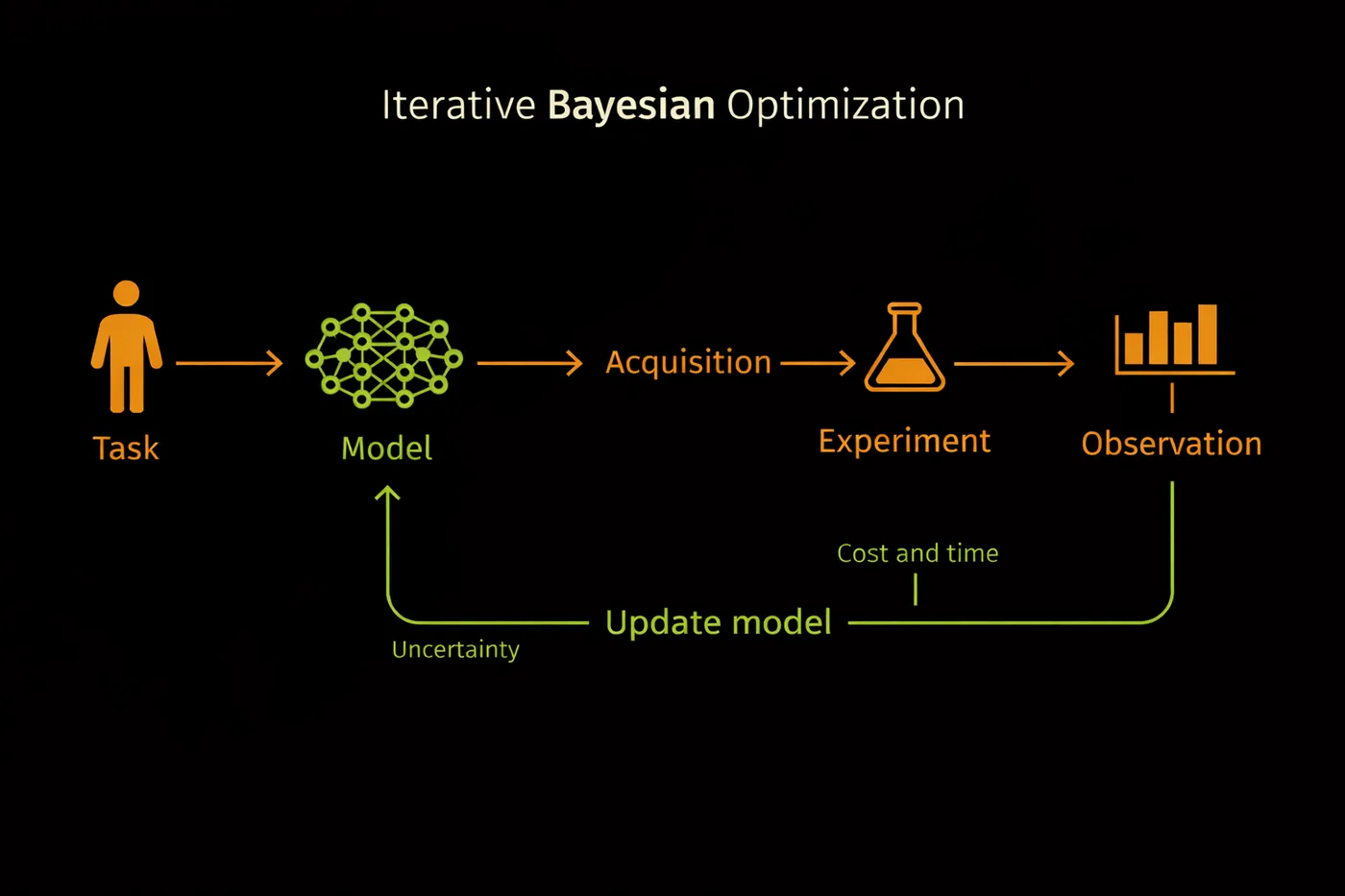
Instead of a fixed plan, it fits a model to the results so far and picks the point where a new result would teach it the most, then updates and repeats. The model carries both an estimate and a confidence for every untested setting, so the choice can weigh a promising prediction against a region nobody has probed yet. Each completed run moves both numbers, which is what makes the next choice different from the last one.
Seed with a small design
A short initial set of runs gives the model something to fit. It does not have to cover the space, it only has to span it.
Fit and quantify what is unknown
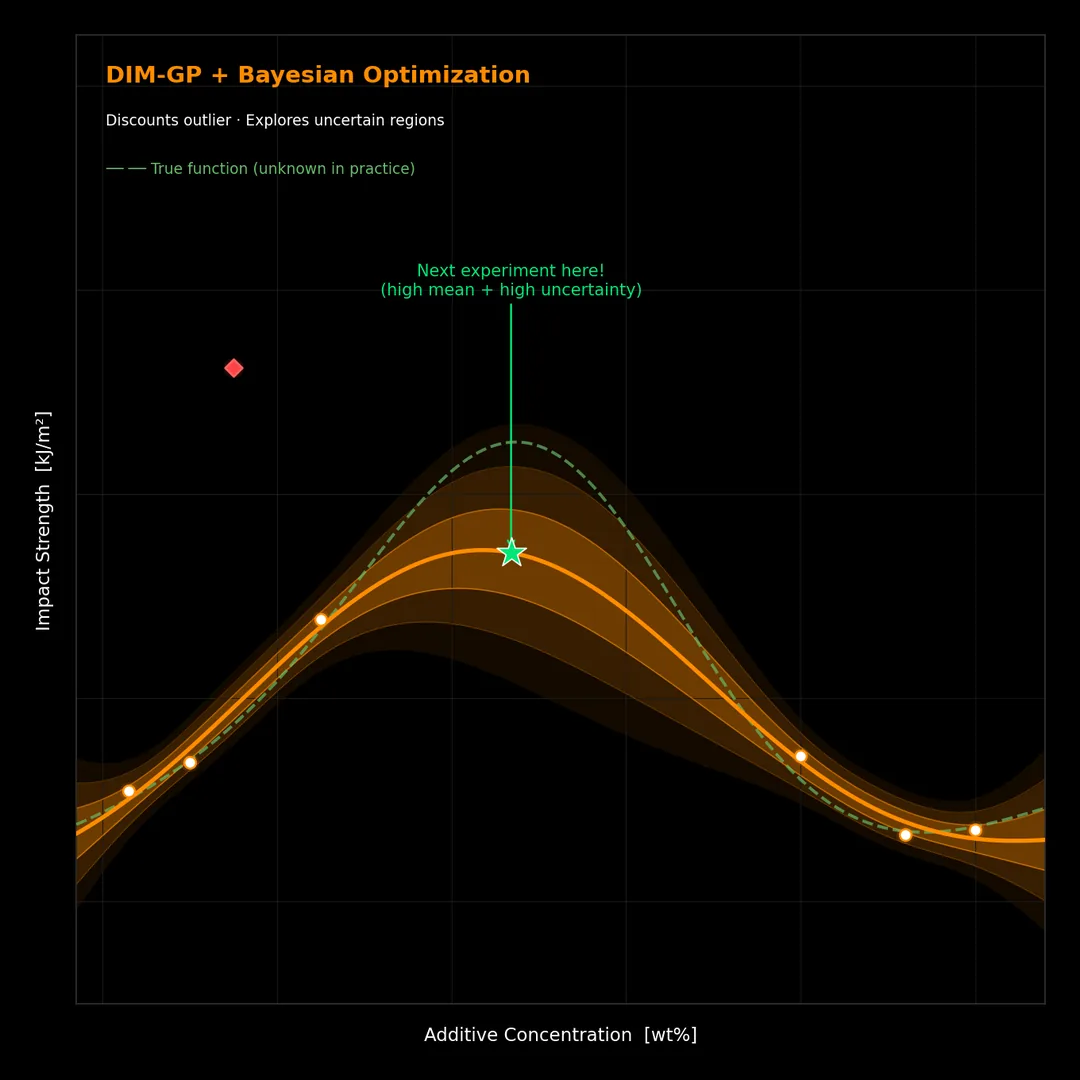
The model returns a predicted response and a confidence for every setting you could try. Confidence is narrow where you have data and wide where you do not.
Score every candidate
An acquisition step ranks untried settings by how much a result there would be worth: strong predicted value, high uncertainty, or a mix of the two.
Run one, then refit
You spend the expensive step once per turn. The result goes back in, the confidence bands move, and the ranking is different next time round.
What two example campaigns took
In an engineering scenario STOCHOS found about 11 percent lower pressure drop in about 47 trials rather than about 600, and in a chemical scenario it reached plus 6.2 points of yield over the incumbent in about 23 runs rather than about 150. Both are examples, each with its own setup; neither is a universal guarantee. In each case the solver, the rig, and the measurement stayed as they were, and only the order of the experiments changed.
Rather than about 600, for about 11 percent lower pressure drop.
Rather than about 150, for plus 6.2 points of yield over the incumbent.
Figures from two specific campaign setups, not a guarantee of what yours will do.
The plan stops being written in advance
The optimizer sits on top of the tools you already run, taking each completed result as its next input, so nothing about how you simulate or test has to change. You keep your solver settings, your rig, and your acceptance criteria. What changes is that the campaign plan stops being written in advance.
Constraints and competing targets go in as part of the problem statement rather than as a filter afterwards, so proposals that cannot be built or cannot be run are not proposed. The method page on Bayesian Optimization covers the acquisition step in detail, and AI for Chemical R&D shows the same loop applied to formulation and scale-up.
Common questions
01Does Bayesian optimization replace design of experiments?
No. A small initial design still seeds the model. Bayesian optimization decides what to run after that, instead of committing the whole budget up front.
02How many runs before Bayesian optimization helps?
It is built for limited, expensive data, so it starts proposing informative points early. The count depends on how many parameters you vary and how noisy the response is.
03What if my objectives conflict?
That is the normal case. Cost against performance, or yield against purity, are handled as a multi-objective problem: STOCHOS returns a trade-off set of best compromises, so you choose the balance instead of guessing it.
The engineering case runs the same loop, with a scoreboard. Take the engineering case