

Where the data ends, a data-only model has nothing to go on
A model trained only on data knows nothing past the last measured point. Each piece of physics you add tells it something about that region.
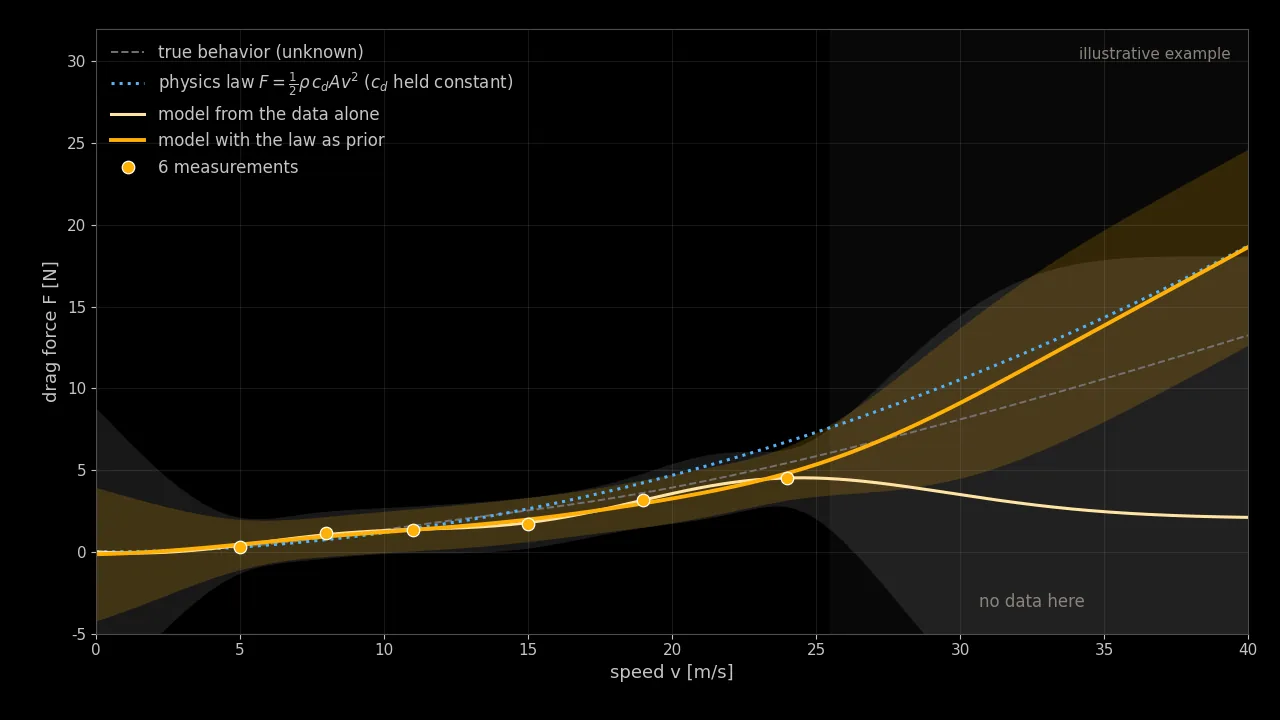
Illustrative example: six drag measurements up to 24 m/s, and the question is the drag at 35 m/s, where nobody measured.
Data only
Between the points the fit is fine. Beyond them, a probabilistic model drifts back toward the average of the data and its uncertainty band widens sharply. Honest, but no use for the question.
Add what you know for sure
Drag never decreases with speed and is never negative. Tell the model, and predictions that break either rule are removed: the curve stops falling beyond the data. How fast it rises is still open.
Add the equation you know
Drag grows with the square of speed: F = ½ ρ cd A v². Not exact, because the drag coefficient cd is not constant, but the shape is right.
Model plus equation
The law becomes the model's prior, and the model learns only the deviation from it. Outside the data, the prediction follows the law instead of the average. Inside, the measurements still correct the law.
Five places physics can enter a model
Physics can reach a model through its data, a baseline it corrects, conditions on its predictions, its design, or its training loss. Which one fits depends on what you know.
| Where the physics enters | What you give the model | Example |
|---|---|---|
| The data | Simulation results at more than one fidelity, test or sensor data | A coarse and a fine mesh in one model; a full field from a few sensors |
| A baseline the model corrects | A law, a formula, or a coarse model | A Wöhler curve, a drag law, a 1-D thermal network |
| Conditions on the prediction | Bounds, trends, balances, or an equation residual that must be zero | Stiffness that stays positive; mixture fractions that sum to one; a heat balance |
| The model's design | Physical structure built into the architecture | A particle model with conservation built in |
| The training loss | A physics penalty, up to the residual of the governing equation | A physics-informed neural network (PINN); a contact penalty in a particle model |
Swipe or scroll horizontally to view all columns →
How STOCHOS takes physics in
STOCHOS is not a physics-informed neural network. Its core algorithm, DIM-GP, combines neural networks and Gaussian processes, and it differs from a PINN in three places:
- Who makes the prediction. The network learns how your data behaves at each point, and a Gaussian process makes the prediction and returns an uncertainty band with it. In a PINN, the network's output is the prediction.
- Where the physics goes. Physics enters as a baseline the model corrects or as conditions applied at prediction time. Adding or tightening a condition needs no retraining.
- What it needs. Simulation or test data. STOCHOS speeds up the evaluation of new variants from runs you already have; it does not solve the equation itself.
What you can give STOCHOS
A baseline it corrects
Give it a Wöhler curve, a drag or Darcy law, a 1-D thermal network, last year's calibrated model, or a coarse mesh. The model learns only what the baseline gets wrong.
Bounds and trends
Damage that never decreases with load, stiffness that stays positive, temperatures above ambient, forces that grow with speed. You set how strictly each one applies.
Sums that must hold
Load shares across mounts, mass and energy balances, mixture fractions that sum to one, a known value at a known operating point. The prediction and its uncertainty band are pulled onto the constraint.
Your equation as a condition
Any differentiable residual that must be zero: an equation of motion, a heat balance, a relation between output channels. Soft or strict, for scalar, signal, and 3D field models.
Physics in the particle model
Energy conservation against drift over long rollouts, incompressibility, prescribed motion for an impeller or a tool, non-penetration as a hard rule at every step, gravity as a known input.
Physics also enters through the data: a multi-fidelity model combines cheap and expensive simulations or tests in one model.
Tested on a published benchmark and in an industry project
On LagrangeBench, a published benchmark of particle-based fluid simulations, the DIM-GP particle model in STOCHOS had lower error than the best of three published baselines in 19 of 21 dataset-metric comparisons, scored with the benchmark's own evaluator.
The model builds conservation and neighborhood structure into its design rather than learning them from scratch. The benchmarks page gives the protocol, the two comparisons it did not win, and the training cost.
Simulation and measurement in one model: with CADFEM, a VAT project linked real measurement data and CFD simulation results to predict flow more precisely.
When this is not the right tool
If you know the full equation and need its solution, use a solver. STOCHOS does not replace the solver or the validation.
Physics keeps predictions plausible outside the data, and plausible is not validated. Before you rely on a prediction far from your data, check it against a run or a test, and read its uncertainty band.
Common questions
01What is physics-informed machine learning?
Machine learning that uses known physics as well as data. The physics can enter through the training data, a baseline the model corrects, conditions on its predictions, the model's design, or its training loss. The model then has less to learn from data and stays plausible where the data ends.
02What is a physics-informed neural network (PINN)?
A neural network trained with the residual of the governing equation in its loss function, so training penalizes any output that breaks the equation. It is one way to do physics-informed machine learning, not the only one.
03How does STOCHOS differ from a PINN?
STOCHOS is not a PINN. In its core algorithm, DIM-GP, a Gaussian process makes the prediction and returns an uncertainty band, while in a PINN the network's output is the prediction itself. Physics enters as a baseline the model corrects or as conditions applied at prediction time, so adding a condition needs no retraining. STOCHOS learns from simulation and test data.
04Do I need the governing equation?
No. A value that cannot go negative, a trend that cannot reverse, a balance, or a coarse model is already physics a model can use. If you have the equation, STOCHOS can take it as a condition, soft or strict.
05How much data does a physics-informed model need?
There is no fixed minimum: the physics covers part of what the data would otherwise have to teach. Above roughly a thousand samples, cheaper methods start to make more sense than a Gaussian process.
Surrogate Modeling
What a surrogate model does, and when it is worth building one.
How STOCHOS works
The DIM-GP model behind the fit, and why it suits small, noisy datasets.
Combine cheap and expensive data
A few costly runs alongside many cheap ones.
News and Guides
Every guide and insight we have published, in one place.