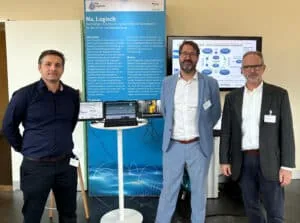

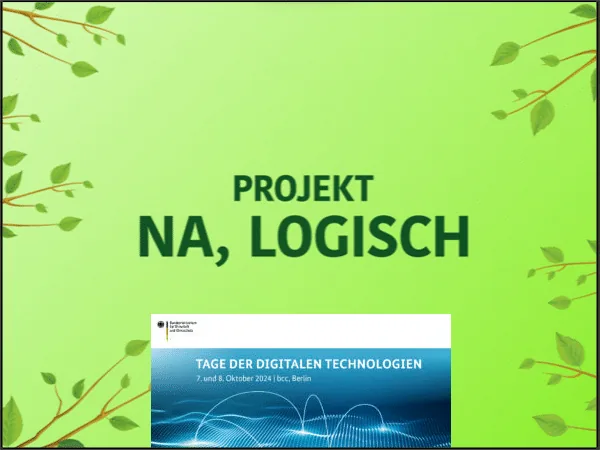
There were two exhausting but very interesting exhibition days at the Days of Digital Technologies 2024 in Berlin, where visitors could see a project on sustainable paint development using probabilistic ML methods, run in collaboration with Mankiewicz, Füll-Lab, the Niederrhein University of Applied Sciences, the Fraunhofer Institute, and of course AOM Systems.
Why the paint value chain needs shared data
Raw material manufacturers, paint manufacturers, and paint processing companies all collect material and process data continuously. None of it is shared or correlated, and it is unclear whether what is collected today even supports valid prediction models. The breadth of the Na, Logisch consortium is what can close that gap.
PI Probaligence and the Niederrhein University of Applied Sciences had already shown the principle worked, optimizing sections of a high-throughput plant with AI.
There is no standardized data exchange along the value chain in paint technology, so the basis for digital technologies has been absent or only partly present. Trial and error is state of the art in paint development, production, and processing, and the error half is expensive.
- Waste. Paint manufacturers record 5 to 30 tons of paint waste a year, depending on production volume.
- Formulations that cannot move. Substituting more than one raw material while keeping the same system performance is almost impossible, so the lab work is often never started because R&D hours are scarce.
- Lines that stop. Painting processes are adjusted until the result is right. On complex systems that can take months, and the components made until then are scrap.
The digital paint twin
The work package description splits the value chain in two, and the twin has to span both.
- Value chain 1. Paint formulation and paint production.
- Value chain 2. Paint application, and how it correlates with the appearance of the painted surface.
Painting is energy-intensive, and when a paint's nature or composition changes over time, for example under REACH, the state-of-the-art process means painting errors and complex adjustment work on the painting system. The digital paint twin being built in Na, Logisch is meant to get paints applied efficiently, with few adjustment attempts.
The technologies developed will be made available to German paint manufacturers and the paint processing industry: digital smart paints in the sense of a digital twin, renewable raw materials made usable, and development times significantly shortened. Processors will adjust the painting process from the prediction models instead of from scrap.
The project also lays the technical foundation for sustainable paint raw materials, whose properties fluctuate strongly, and for adapting existing recipes quickly at benchmark quality, for example when rules such as REACH restrict CMR substances.
Project homepage: greentech-na-logisch.online