

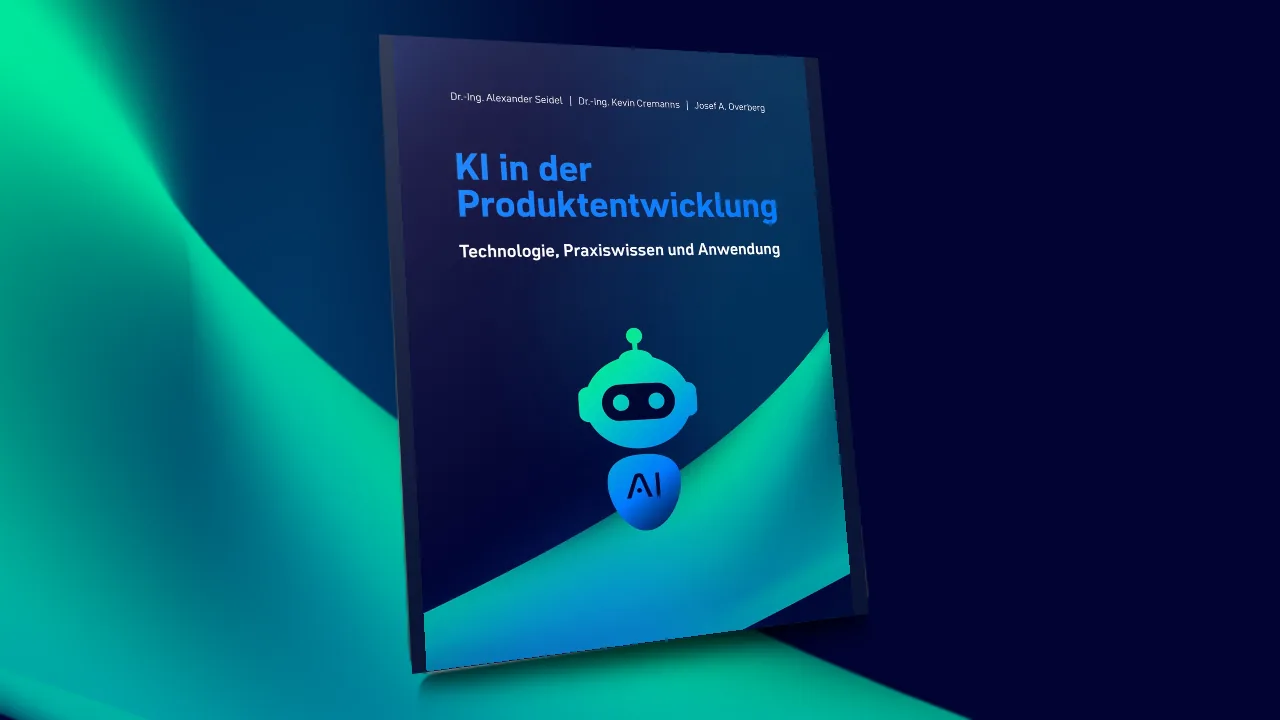
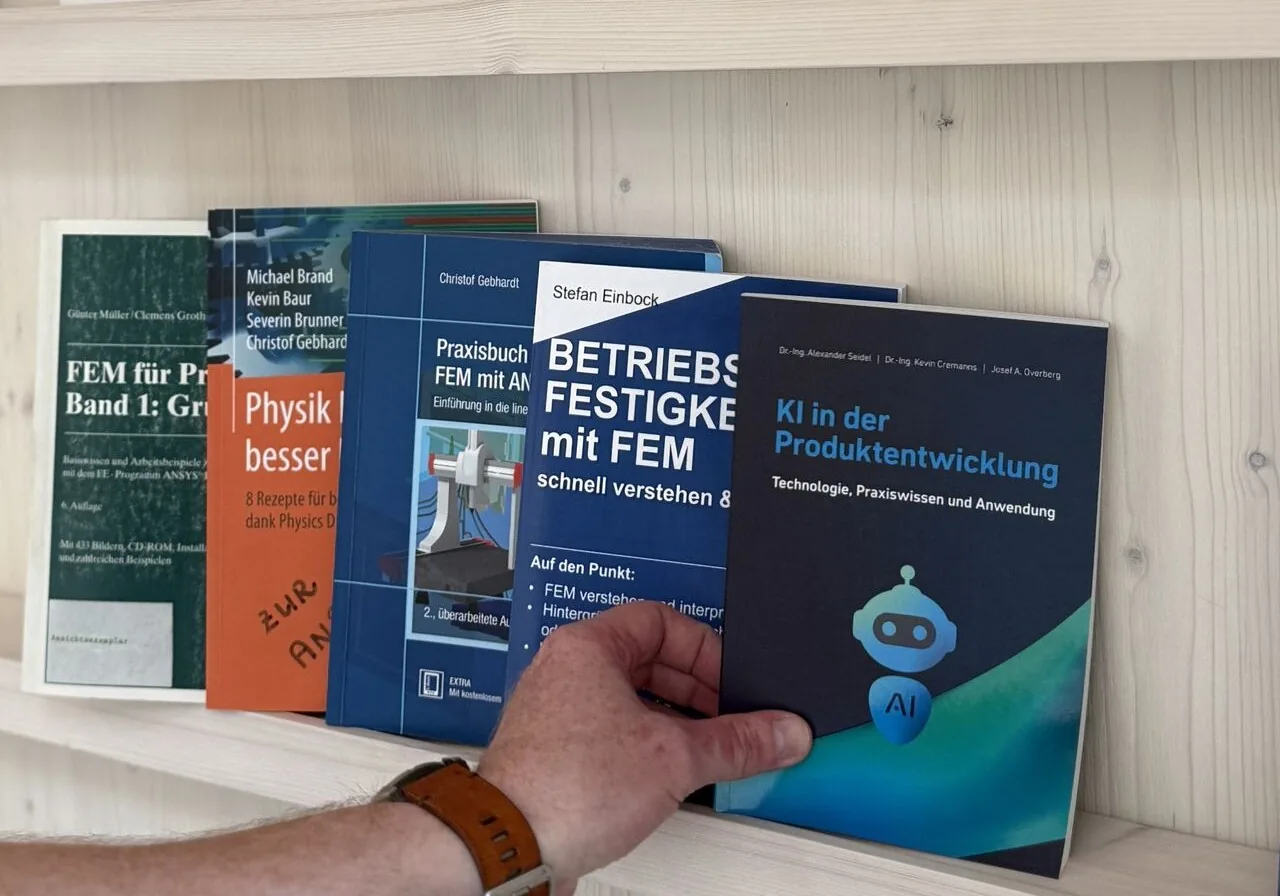
For much of the current discussion, the answer starts with language models. "KI in der Produktentwicklung: Technologie, Praxiswissen und Anwendung" takes a broader view. The new technical book covers the numerical, data-driven AI used with simulation results, test data and physical systems, alongside the language models that have brought AI into everyday use.
Published by Vogel Professional Education in July 2026, the German-language book runs to 226 pages. Its authors are Dr.-Ing. Alexander Seidel, Dr.-Ing. Kevin Cremanns and Josef A. Overberg.
Cremanns is co-founder of PI Probaligence. Seidel and Overberg are from CADFEM Germany GmbH, where Overberg is managing director. PI Probaligence has been part of CADFEM Group since 2024.
From models and data to engineering use cases
The book is organised into five parts. Cremanns worked on the first three.
The first looks underneath the term AI itself. It covers neural networks, how models learn, overfitting, computing requirements, on-premise and cloud approaches, and a question that matters particularly in engineering: how do you know whether a model's prediction is trustworthy?
The second turns to data. How much is actually required? What determines that amount? Which useful data already exists inside a company? And what matters more, quantity or quality?
The third moves into applications across product development. It covers concept selection, generative and analytical approaches in design, analysis, design of experiments, combining virtual and physical test data, and anomaly detection in operation.
Parts four and five, written by his co-authors, deal with implementation and with the changing division of work between engineers and AI.
The result is less a catalogue of AI technologies than a guide to the decisions around using them.
Where STOCHOS appears
STOCHOS is highlighted in the book, in the chapter about assessing whether an AI result can be trusted.
> Leichter einschätzen können Sie die Qualität der Ergebnisse, wenn Sie eine probabilistische KI nutzen, zum Beispiel Stochos von PI Probaligence.
In English: you can assess the quality of the results more easily when using a probabilistic AI, for example STOCHOS from PI Probaligence.
That passage goes directly to one of the central differences between conventional deterministic and probabilistic machine learning. Instead of returning only a prediction, a probabilistic model also provides information about its uncertainty. An engineer can then judge whether the prediction is sufficient for the decision at hand or whether another experiment or simulation is needed.
The book describes STOCHOS as combining neural networks and Gaussian processes and handling scalars, signals, fields, tensors, CAD geometries, FEM and CFD node results, images and time series. It also notes that users do not have to set hyperparameters themselves.
Quoted from the CADFEM eBook edition with permission.
Why it is relevant to engineering teams
The difficult questions around AI in engineering tend to appear before and after model training.
Do you have enough useful data? Is the problem suitable for AI in the first place? Can you tell when a prediction should not be trusted? How does a proof of concept become something engineers actually use?
Those are the questions the book spends much of its time on. They are also the questions that tend to determine whether an AI project becomes useful engineering work or remains an isolated experiment.
Learn more: See how STOCHOS combines surrogate modeling with uncertainty quantification to return predictions together with a confidence interval.