

A model only you can run helps only you
A model finished on the modeller's laptop, in their Python environment, is worth exactly one person's availability. Everyone else who wants a prediction sends the inputs over chat and waits for a number to come back, and the queue is however busy that person happens to be.
The usual workaround is a written note: here is how you install it, here are the columns, here is the order of the arguments. Half the questions still land back on the modeller, because a manual cannot answer the case it did not anticipate.
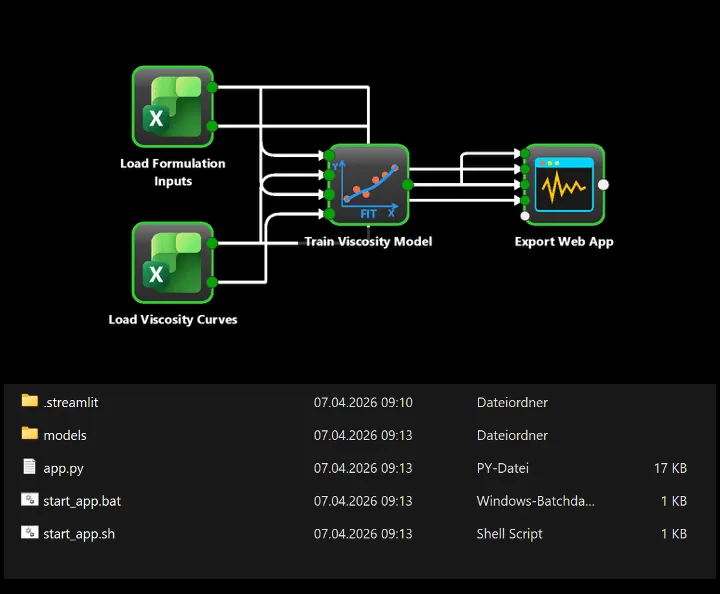
Export the workflow as an app, hand over a link
The Export Web App node in STOCHOS Flow turns a finished workflow into a standalone Streamlit app. The person using it moves the sliders and reads the result. In the episode example, a polymer viscosity model with a handful of formulation inputs became an app a colleague could drive without ever opening Flow.
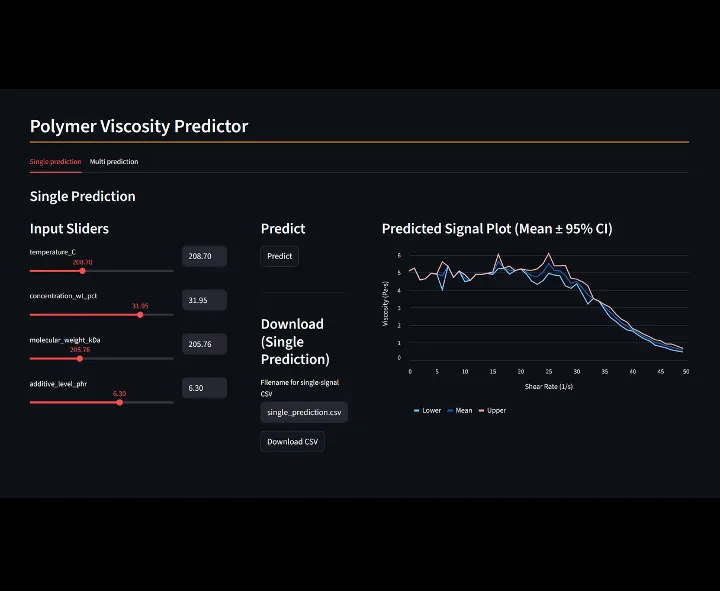
- Input sliders
- One control per model input, moved within the ranges the workflow was built on.
- Prediction with 95 percent band
- The mean prediction and its confidence interval together, so the reader sees the range, not a bare number.
- CSV download
- The inputs and predictions written out to a file, ready for the next step or the record.
- Runs standalone
- A Streamlit app that opens in a browser. No Flow, and no Python environment, on the colleague's side.
The confidence band is the part that matters most in the handover. It is the model speaking: DIM-GP predicts a mean and an interval, and the app carries both through, so a colleague deciding from it works with the range rather than a point that looks more certain than it is.
Common questions
01Do my colleagues need Python to use the app?
No. The Export Web App node produces a standalone Streamlit app that opens in a browser. The people using it set the inputs and read the result; they do not install a Python environment.
02Does the confidence band come through to the app?
Yes. The band is the model speaking: DIM-GP predicts a mean and an interval, and the exported app shows both, so a decision made from the app inherits the uncertainty instead of losing it.
03What happens when I retrain the model?
Export again. The app reflects whichever workflow produced it, so once the retrained workflow is ready you generate a fresh app from it and share that.
STOCHOS Flow
The workflow layer: build the pipeline as a node graph, then export it as an app or a package.
Uncertainty Quantification
Where the confidence band comes from, and why it belongs next to every prediction.
When can you trust an AI prediction?
How to read the band your colleagues now see, and when it says go back to the solver.
News and Guides
Short answers to the questions engineers ask us, in one place.