
Every workflow hits a step no toolbox ships
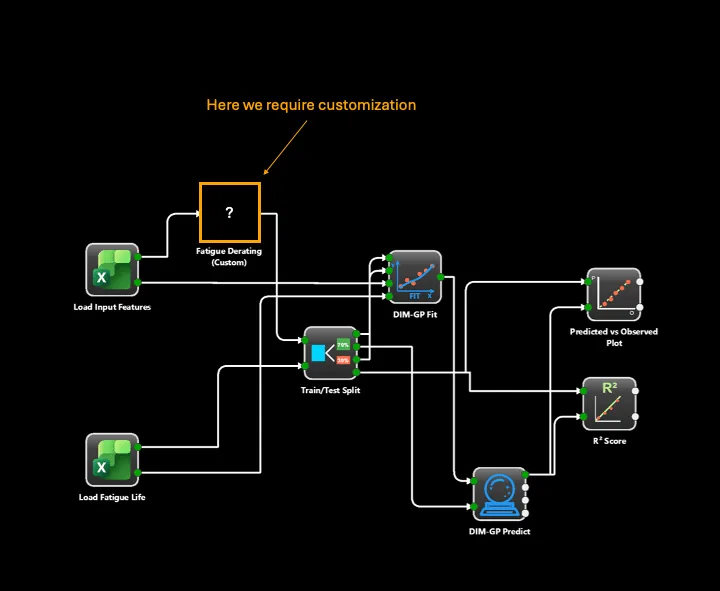
Sooner or later a workflow needs logic that no node palette covers. A fatigue-derating step that applies a company standard is the classic case: the rule matters on every project, and no vendor will ever ship it, because it is yours.
The usual fix was to wait for whoever writes Python. The script arrived days later, worked, and then lived in that one person's folder. The next project rewrote it from memory, slightly differently, and nobody could say which copy still matched the standard.
Describe the step, review the code, share the node
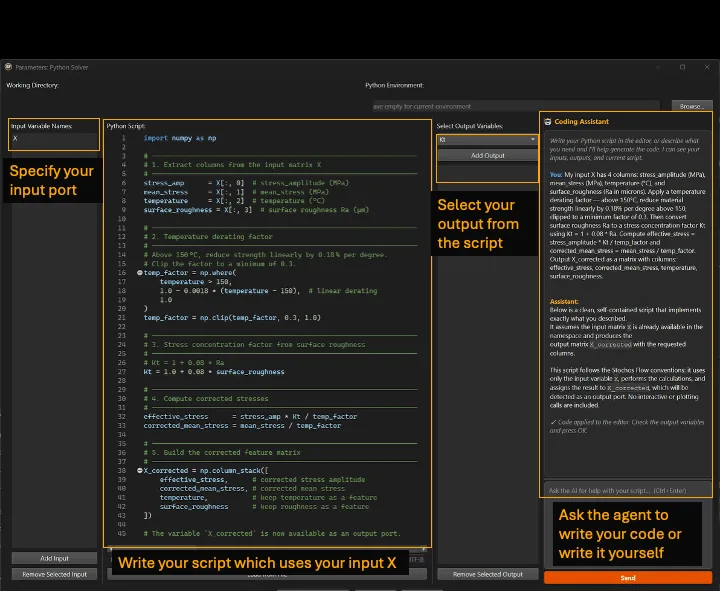
The Python Solver node in STOCHOS Flow takes that custom logic without the wait. You describe the step in plain language and the built-in coding assistant drafts the script, so you start from a working first version instead of an empty editor. The assistant only drafts. You read the code, change what is wrong, and decide when it runs.
- 01 Describe
- You write what the step should do, in plain language: apply the derating rule from the company standard to the fatigue result.
- 02 Draft
- The AI coding assistant turns the description into a first draft of the Python script.
- 03 Review
- You read the draft, correct it, and test it. Nothing runs until you accept the code.
- 04 Export
- The finished step becomes a reusable node the whole team can drop into their own workflows.
Once the step behaves, export it. The derating rule stops being a private script and becomes a shared, versioned building block: one definition the team maintains instead of five diverging copies in five folders.
Common questions
01Do I have to trust the code the assistant writes?
No. The assistant drafts a script inside the Python Solver node; nothing runs until you have read it, edited it, and accepted it. Treat the draft the way you would a first version from a colleague.
02What happens to the step once it works?
You can export it as a reusable node. It then sits alongside the built-in nodes, so colleagues add the same rule to their own workflows instead of rewriting the script.
03Does the AI assistance need a cloud connection?
Not necessarily. STOCHOS Flow is local-first: the assistant can run against a local LLM via Ollama, with cloud models as an option. In a local setup your data stays on your own infrastructure.
STOCHOS Flow
The workflow layer: visual canvas, AI assistance, and the Python Solver node for custom logic.
STOCHOS
The predictive engine the workflows run on: probabilistic models with quantified uncertainty.
Build an ML workflow without an ML team
What the rest of the workflow looks like when nobody does ML full time.
News and Guides
Short answers to the questions engineers ask us, in one place.