

The document always trails the analysis
The workflow finishes on Tuesday and the report is still open on Friday, because the document gets assembled by hand: screenshots pasted in, captions typed, the method section reconstructed from memory. Then someone changes a boundary condition, the workflow reruns, and every figure in the document is stale again.
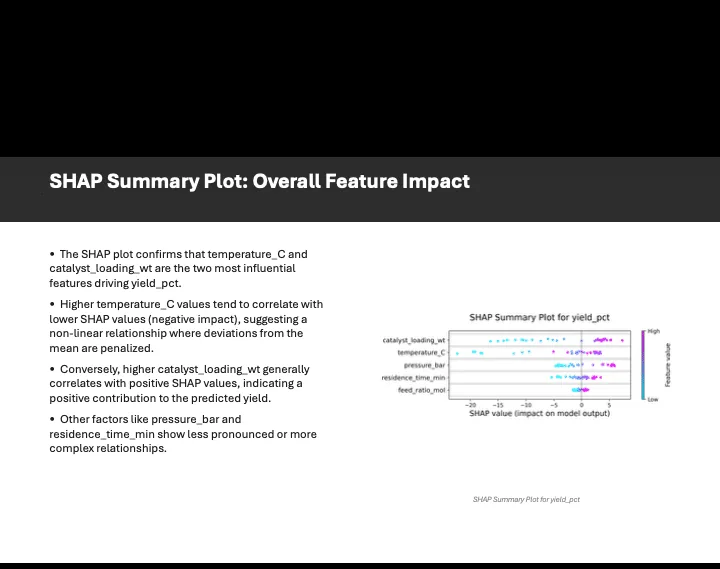
The AI Report Generator in STOCHOS Flow removes that assembly step. It walks every node of the finished workflow and drafts a structured report of what ran and what came out, and vision models write the captions for the figures. The predictions themselves still come from the STOCHOS models in the workflow; the generator documents them, it does not produce them.
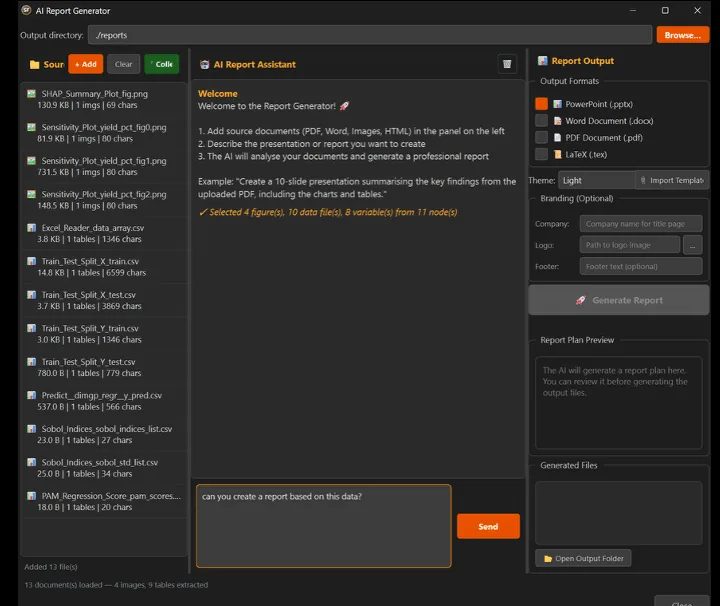
One draft, four export formats
The draft is a starting point, not a finished document. You read it, correct it, cut what the audience does not need, and then export it in whichever format the project expects.
For the design review, where the results were headed anyway.
For the written report that goes into the project file.
For the fixed record that nobody can quietly edit later.
For papers and reports that go through a typeset pipeline.
The part that changes the habit is the rerun. When the workflow runs again, the report regenerates from the updated results, so the document that goes out matches the numbers that were actually computed rather than the ones from two reruns ago.
Common questions
01Does the Report Generator change or rerun my analysis?
No. It reads the workflow after it has run and documents the nodes and their results. The predictions come from the STOCHOS models in the workflow; the generator writes the document, nothing else.
02Can I trust the generated text without checking it?
Treat it as a draft. The structure and the figures come from the workflow itself, but the wording is generated, so the engineer reads and edits before anything is exported. That review step is part of the design, not a workaround.
03Does report generation need a cloud service?
STOCHOS Flow is local-first. The AI assistance can run on a local LLM via Ollama, with cloud models as an option where a team wants them. In local setups your data stays on your infrastructure.
STOCHOS Flow
The workflow environment the Report Generator is part of.
STOCHOS
The predictive engine behind the results the report documents.
Build an ML workflow without an ML team
How the workflow gets built and validated in the first place.
News and Guides
Everything we have published, in one place.