

Plausible code is not working code
A general assistant has read the public internet. Your solver macros, your naming conventions, and your internal method notes are not on it. Ask for code against a niche simulation API and the answer arrives fluent and confident, with plausible calls to functions that do not exist.
That failure mode is worse than a blank answer, because plausible code gets pasted into real workflows before anyone checks the import.
With the docs indexed, the code runs
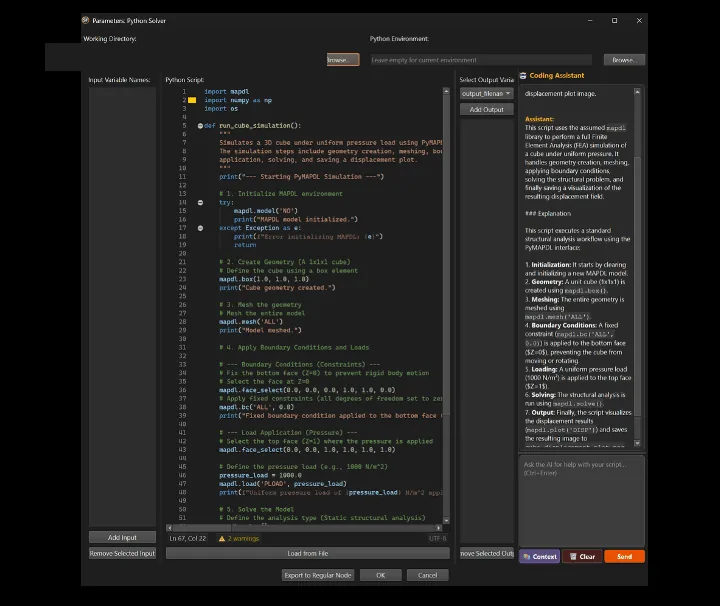
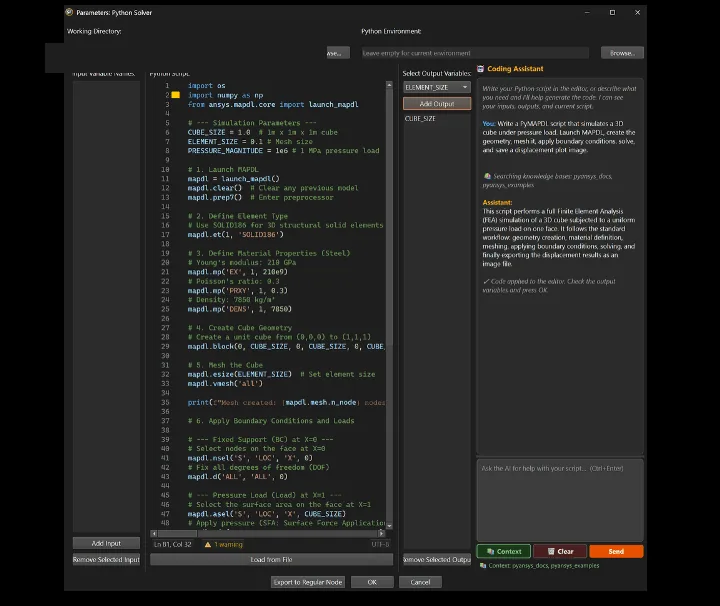
Knowledge bases in STOCHOS Flow index your own docs, code, data, and PDFs, and any AI node can use them as context. We put that to the test in a demo: the same request for code against a niche simulation API, first from general training alone, then with the documentation base attached.
The assistant answers from general training.
The code looks right: familiar shape, familiar names.
It fails at import. The interface it wrote against is not the real one.
The assistant answers from your documentation.
The code calls the API as documented.
It runs, and the analysis completes.
One demo, not a benchmark, so take it as a contrast rather than a statistic. The index is built and stays on your infrastructure, which is what makes it usable for confidential material. How the bases, the AI nodes, and the assistant fit together is on the STOCHOS Flow page.
Common questions
01Does my documentation leave my machine?
No. The base is built and queried locally. STOCHOS Flow is local-first: the assistant can run against a local LLM via Ollama, and cloud models stay optional, so nothing forces your documentation through an external service.
02Does indexing the docs guarantee correct code?
No, and we do not claim it does. In the demo the difference was code that failed at import versus code that ran. The index gives the assistant the real interface instead of a guess; reviewing and validating the output stays your job.
03Do knowledge bases change what the DIM-GP models predict?
No. A knowledge base feeds context to the AI assistant that writes code and wires workflows. The DIM-GP models that produce predictions are trained on your data and behave exactly the same with or without a base attached.
STOCHOS Flow
The workflow layer: AI nodes, knowledge bases, and the assistant that wires them together.
On-Premise AI for Engineering
Why teams keep the assistant and the models on their own hardware.
STOCHOS
The predictive engine: fast surrogate models with quantified uncertainty.
News and Guides
Every guide and insight we have published, in one place.